



By Riley Kaminer
For Camilo Buscaron, his entrepreneurial journey feels like a full-circle moment. Having spent years in Silicon Valley working on robotics and artificial intelligence projects, Buscaron has returned to his hometown of Miami to lead Alafia, a company on a mission to reshape the way healthcare professionals use technology.
“For me, it’s the American dream,” Buscaron told Refresh Miami. “I’m from Hialeah, went to high school in Miami Springs, and now I live just a few blocks away from where I grew up. It’s amazing to be back and contribute to the community.”
Buscaron’s path to Alafia started in the early 2000s when he made a name for himself in the robotics space. He was an early engineer at Fetch Robotics, a company that helped fill a market gap left after Amazon acquired Kiva Systems.
“Fetch was in the right place at the right time,” said Buscaron [pictured above].. The startup thrived, eventually achieving a significant exit. From there, Buscaron joined chip giant NVIDIA, where he played a key role in the automotive program during a major period of growth for the company.
But it was his tenure at Amazon Web Services that planted the seeds for Alafia. There, Buscaron developed open-source computer vision technology that gained significant traction, with millions of monthly downloads and hundreds of contributors. As he delved deeper into the data, an unexpected insight emerged: A substantial number of users were researchers in medical imaging. This revelation ultimately inspired him to leave AWS and explore ways to commercialize the technology.
Alafia, founded in 2023, focuses on creating advanced computing solutions for healthcare professionals. Its origins trace back to a meeting with Baptist Health in Miami. “We were in the imaging center,” Buscaron said, “and they had these state-of-the-art MRI scanners paired with ancient Windows 95 systems. We realized their foundational problem wasn’t just AI adoption – it was infrastructure modernization.”
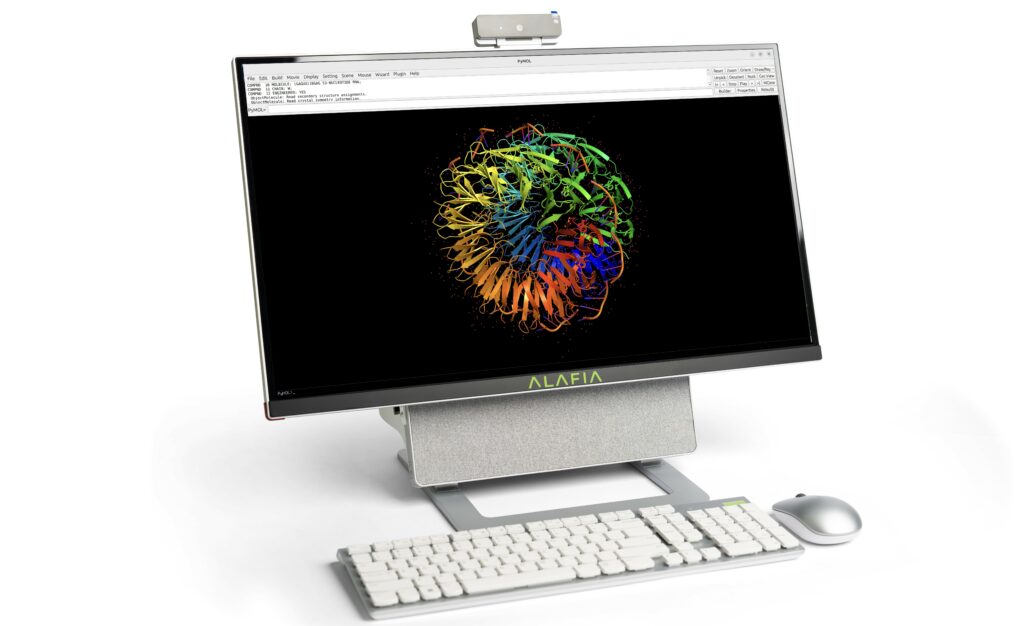
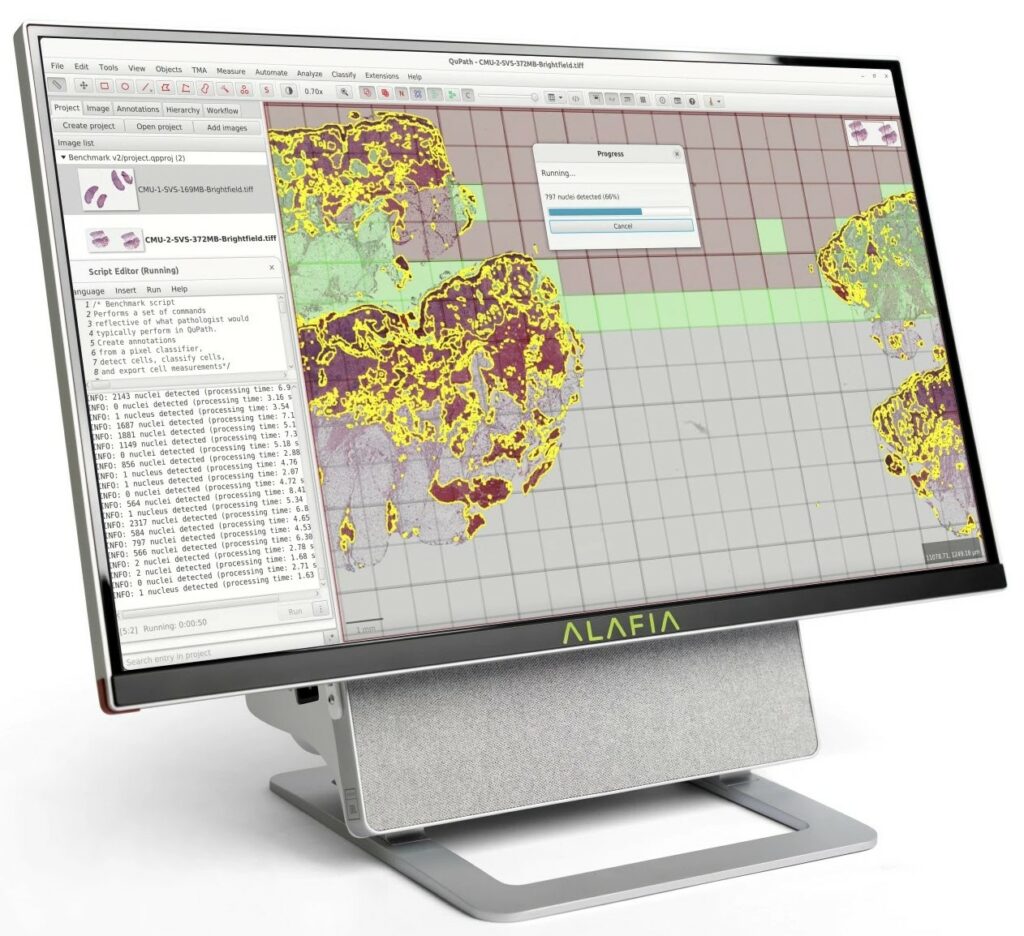
This epiphany shaped Alafia’s mission to build products that bridge the gap between legacy systems and cutting-edge computational tools. The company’s initial customers have been medical researchers, bioinformaticians, and healthcare developers, with a focus on enabling new possibilities in computational pathology and radiology.
“Our product allows researchers and doctors to try things they previously couldn’t do in real-time,” Buscaron said. “It opens up new opportunities for insights and treatments.”
Despite its niche focus, Alafia has gained attention from top-tier institutions like Stanford and Harvard, working on projects ranging from neurology to oncology. For example, its technology is used in transcranial magnetic stimulation therapy, guiding doctors with precise imaging to improve patient outcomes.
Today, Buscaron splits his time between Miami, Gainesville – where Alafia’s hardware design team is based (the University of Florida is his alma mater) – and customer sites.
Miami, however, remains central to Alafia’s story. “When I moved back three years ago, it was amazing to see how much the city’s tech scene had grown,” he said. “Miami’s becoming a fintech hub for Latin America and a magnet for startups.”
Alafia has been bootstrapped thus far. “Right now, we’re focused on delivering products to our customers,” Buscaron explained. “We might not even need to raise much capital.”
Looking ahead, Buscaron is optimistic about the future of healthcare technology. “Our product enables applications that were previously unimaginable,” he said. “Whether it’s running complex simulations for radiation treatments or leveraging machine learning to analyze tissue samples in real time, we’re only scratching the surface of what’s possible.”
READ MORE IN REFRESH MIAMI:
- Special Report: Meet the startups shaping the future of healthcare, from Miami to the world
- With $2M in tow, AI startup CodeComply.Ai aims to accelerate construction approvals and reshape compliance checks
- 1.5 million people are using CodeGPT to rethink software development with AI
- With $3.5B valuation, Vultr raises $333 million to expand AI infrastructure
- Pens at the ready! Spines secures $16M to revolutionize publishing with AI

- Comp AI turns compliance headaches into a $34M Series A - September 17, 2026
- Zèya zooms past 100,000 downloads, sets its sights on the next million - September 16, 2026
- Grip is taking the guesswork out of shipping the cold stuff - September 15, 2026