



When a couple hundred South Florida leaders from companies, universities, bootcamps and community support organizations come together to focus on building a stronger tech talent pipeline, new ideas get surfaced, important connections are made, and collaborative efforts strengthen. And it’s not just talk – it’s action.
“We can’t talk about economic development without workforce development. One of the first things that we needed to do as a Tech Talent Coalition was refute the theory that there’s no tech talent happening in Miami. We’ve invested heavily in ensuring that our talent pipeline is more than ready to meet employer needs,” says Terri-Ann Brown, director Miami Tech Works, a major initiative formed to create pathways to well-paying tech jobs in South Florida. It is funded by a $10 million grant from the US Economic Development Administration.
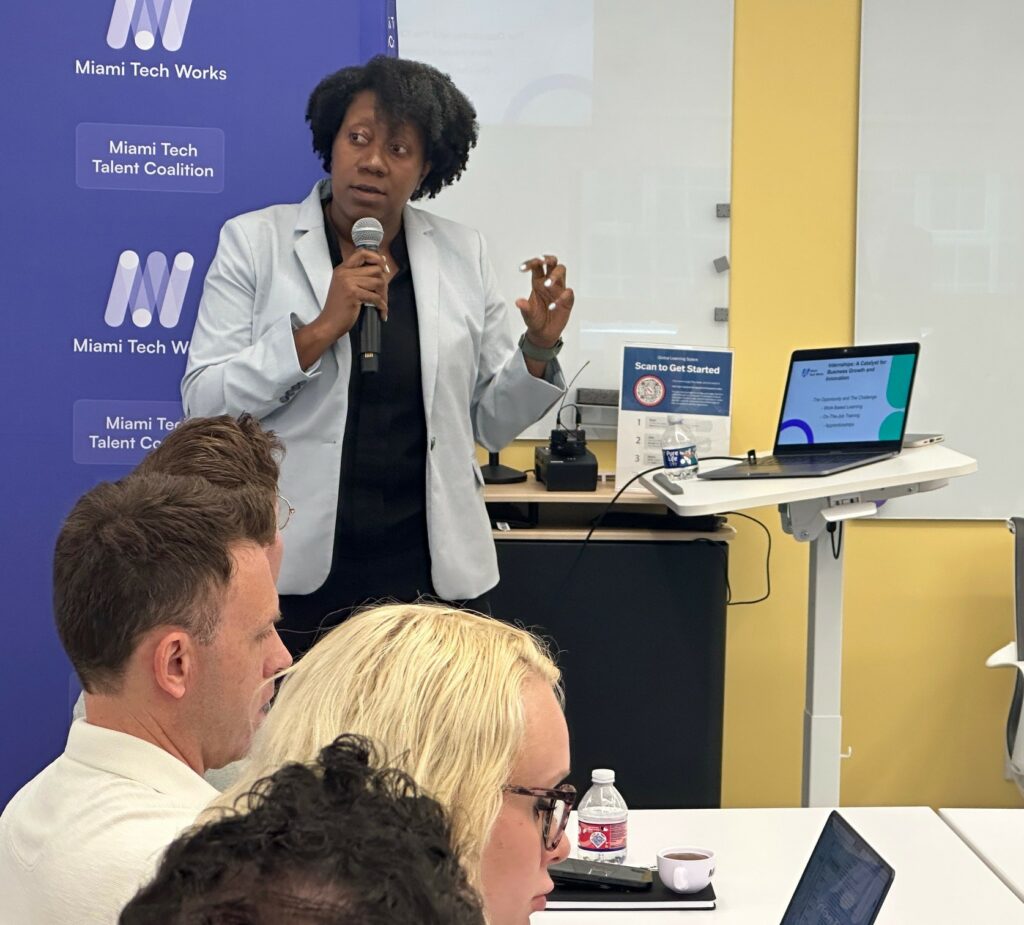
In the first two years of Miami Tech Works, over 2,000 students and South Florida residents have enrolled in Miami Tech Works-funded programs for tech training. Of those, several hundred have completed or are in the process of completing paid internships. Best news: 385 students have been placed in full-time tech positions, with a goal to reach 500 later this year. “But there’s still a lot of work to be done,” Brown says.
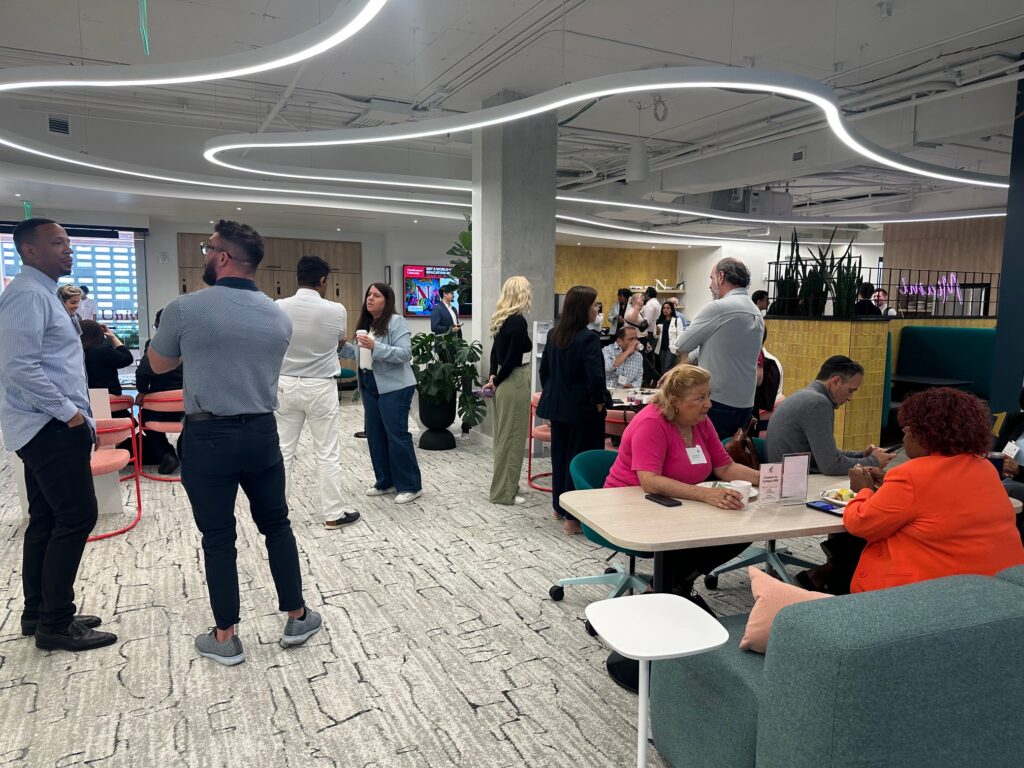
To that end, Miami Tech Work’s Miami Tech Talent Coalition, a group of employers, training providers and other community leaders on a mission to create pathways for our region’s tech talent, held their 11th in-person gathering since the launch of Miami Tech Works two years ago. The meeting, held at Northeastern Miami’s new campus in Wynwood, also marked the start of an expanded focus for Miami Tech Works’ mission for its 3rd year, says Brown. Last year, the county was declared a US Tech Hub in the climate technology space. With that came $19 million in grant funding to develop the tech hub. As a region, Greater Miami is “going to double down on infrastructure, construction, carbon reducing concrete, and other ways that we can help mitigate some of our climate challenges,” Brown said, and Miami Tech Works will be focusing on ensuring the talent pipeline is more than ready to meet employer needs for the tech hub.
Another new development is that Miami Tech Works expanded the programs that it is supporting by including School of Business students in Miami Dade College. That’s because jobs in finance, business management, and supply chain and logistics among other require very tech-aligned skills, especially as we continue to venture into Applied AI, Brown says.
Aligning the skills with what the employers need remains a key goal of Miami Tech Works, Brown says. “The reason we have working groups for employers is because we’ve got to get to work as a community to identify why we still have gaps where employers say they can’t find the talent. When we look at some of this internship data and early career data, we see that there’s currently not enough local opportunities available for the number of students that are graduating.”
More employers need to offer relevant work-based learning experiences for students, said Brown. “Our call to action is for employers to become more actively engaged in the training and development process with our training providers.”
One way to do that is through a new work-based learning project that is available for employers at no cost to them, through a partnership with the US Chamber of Commerce Foundation. It’s called EPIC (Employer Provided Innovation Challenge). If an employer has a well-thought-out short-term project, they can get a team of up to five students to work on the project, allowing the students to obtain a relevant work-based learning experience and the employer to get an innovative project done. And that is just one of the opportunities available to employers, Brown told the employers in the room. “The bottom line is there are solutions made available for you.” Learn more about the local EPIC opportunity and apply here.
To meet these challenges, Miami Tech Works’ Miami Tech Talent Coalition hosts four work groups: Emerging Tech Talent, Small Business Capacity Building, Tech Skills Gap, and Talent Pipeline Management. These groups have been meeting for the last two years and are always looking for new members among interested employers and community members.
“The working groups are really the meat of the coalition,” said Caryn Lavernia, a Lab22C VP and a facilitator for the Coalition. To the employers in the room, she added, “We will find resources for you, we will find experts for you. You just need to come up with really great ideas around how we build living wage jobs in Miami, and how we retain our tech talent here and get them ready and trained for those really great living wage jobs.”
During this meeting, the four work groups broke off to discuss their projects and next steps. Here are a few ways those working groups are aiming to make real impact in creating pathways for the region’s emerging talent:
Emerging Tech Talent Work Group
After discussing how sometimes it is difficult to know which person to reach out to at a university or employer, for instance, the Emerging Tech Talent workgroup came up with a need that will turn into a project for them: a centralized online listing that makes it easier for employers, training providers and job seekers to find out more information or connect. It would include open training opportunities that are out there, whether those are from the colleges or coding bootcamps, employers who are hiring and what they are looking for, and perhaps even students and residents who are looking for jobs, all with contact information making it easy to find the right person and connect.
The group also talked about professional apprenticeships, which the group has been trying very hard to push forward. Unfortunately, they have not been adopted by employers, and internships have been easier for employers to offer. “The outcome of that is that we need more employer involvement. If you are an employer in the room that is able to offer internships, we encourage you to contact us, because we have great talent from a number of providers who can easily be plugged into the projects that you’re working on,” said Ken Finneran, CHRO at eMed and one of the leaders of the Emerging Tech Talent group.
Notably, during this 45-minute discussion, a handful of key connections were made for potential future projects or collaborations, showcasing the power of getting everyone into the same room – quite literally.

Talent Pipeline Management Work Group
This new group is open to employers only. There is a significant issue with mid-career talent leaving the region for cities with lower costs of living. Retention strategies discussed by the Pipeline Management work group included succession planning, early intervention, leadership training for mid-level managers, and contractual agreements tied to subsidized learning. Small businesses, which make up the majority of local employers, are especially vulnerable to losing key employees because they often lack the resources or awareness to implement proactive retention and workforce development strategies, unlike larger corporations.
The group emphasizes upskilling existing employees as the most effective way to fill talent gaps, rather than relying solely on external recruitment. This includes creating tailored training programs based on company needs and nurturing ongoing relationships with employers to adapt to changing skill requirements. Creative use of grants, subsidies, and possibly investor funding could support workforce development, especially for small businesses. There’s also a recognized need to strengthen HR and leadership skills within companies to better address retention and effective upskilling in workforce development, moving from reactive to proactive strategies. “The conversation concluded with the recognition that while upskilling and retention strategies are essential, many companies — especially small businesses — are not yet prioritizing them,” said Brown, who facilitated the conversation. “The group is exploring how to help companies, especially small businesses, retain and upskill talent in a challenging economic environment, favoring enterprise-funded training and ongoing employer engagement over traditional apprenticeships, and highlighting the need for stronger HR leadership and creative funding solutions.
Small Business Capacity Building and Tech Skills Gap Work Groups
In the Small Business Capacity Work Group’s discussion, there were a number of organizations that help match emerging talent with potential employers as well as a couple of representatives from higher education, but ironically, there wasn’t as much representation from actual small businesses. The goal of this work group is to recruit more small businesses to share their pain points, tech talent needs and their requirements for those jobs — and join the working group. They would also like to expand on their success with micro-internship projects and find other ways to support small business growth leverage talent with training providers.
The Tech Skills Gap Work Group discussed examples of companies that are here trying to hire but felt like the local applicants didn’t have the right set of skills, including soft skills and sales skills, and they heard from a representative in sales. However, the Tech Skills Gap didn’t identify a project during this discussion, so stay tuned for the June 12 meeting for more about this group.
Sign up for a Working Group here.
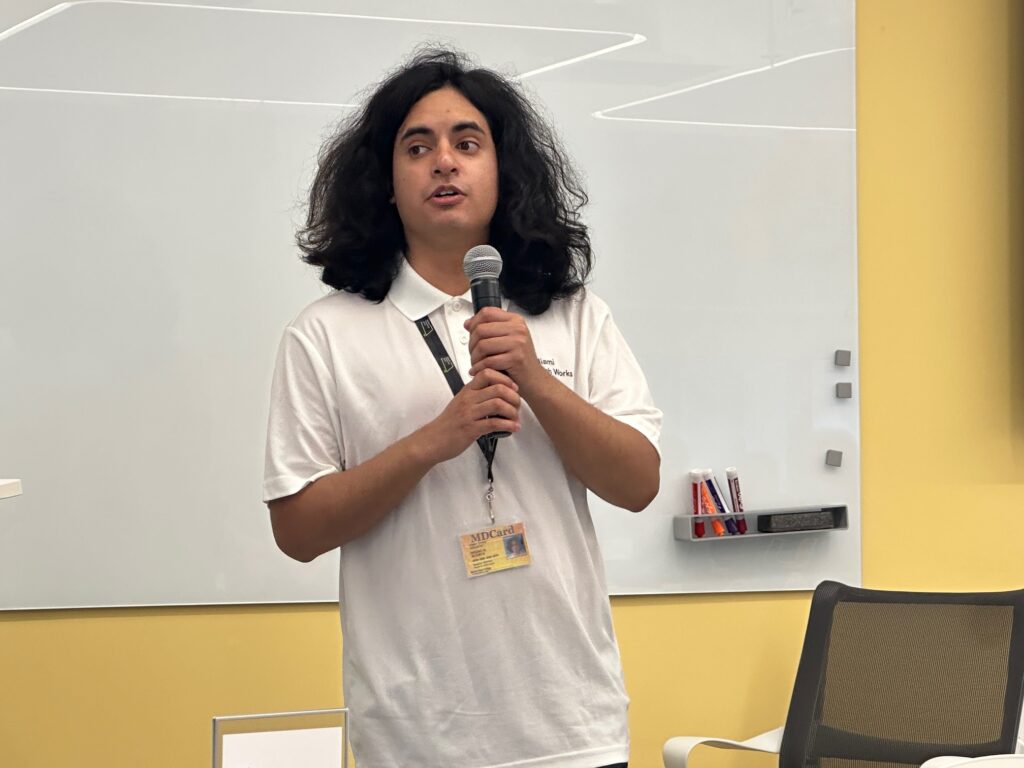
If the Miami Tech Talent Coalition members needed any inspiration for their mission, one of Miami Tech Works’ student ambassadors, Bruno Acosta [pictured below], delivered. He gave a short talk about his student project for the hospitality industry using AI. He is creating an app that helps restaurants measure and analyze actual food waste (often from oversized portions) with technology. He’s studying software engineering at Miami Dade College and interning through MDC’s Apple Swift program. He and other students will be presenting their projects at an upcoming Career Development Day at MDC.
Maria Alonso, Northeastern University Miami‘s regional dean and CEO, introduced the crowd to the new Wynwood campus and what’s ahead. With Miami Dade College, Northeastern unlocks a pathway for graduates with tech-focused bachelor’s degree to some of Northeastern’s master’s programs. A fintech management master’s degree is coming this fall, and Applied Ai program is on the way too, she said. On the entrepreneurship front, Northeastern started the Miami Innovation Academy; its second cohort recently finished and the next one will be in the Fall.
“We share the mission and vision of the Coalition. This is important for the success of our community, of which we are all stakeholders,” Alonso said. “We’re here to be part of this community, to contribute to its success, and to work with all of you in doing that.”
Mark your calendars: The next Miami Tech Talent Coalition meeting will be June 12 at The LAB Miami in Wynwood. Register here.
READ MORE IN REFRESH MIAMI:
- From Venezuela to FIU and soon Microsoft: Meet this computer science student making waves in the Miami tech ecosystem
- How Miami Tech Works and its partners aim to keep the region’s emerging tech talent right here
- At the Tech Talent Summits and Fest, smart job-hunting advice was in abundance. Here’s some of the best.
- MDC and Apple create a Swift pathway to work experience in tech
- How Break Through Tech Miami bridges the gap between classroom and industry
- The data is in: We have tech talent, but are not retaining it. Now what?
- And more here.
Refresh Miami is a proud Miami Tech Works partner.

- 6+ things to know in #MiamiTech: Congrats to Clem, welcome to Nu, plus news from NextEra, Space-Eyes, Mana Tech, Monashees, Mark Cuban Foundation & more - September 6, 2026
- Top AIG exec to join Palantir to lead global financial services - September 2, 2026
- 8+ things to know in #MiamiTech: News from NEXA, A1R water, SPARC South Florida, tech salaries, Guident, Remitian, jobs opportunities & more - August 29, 2026