



By Riley Kaminer
In 2022, the idea of using Bitcoin as collateral for home loans turned heads, attracting customers and banks alike. But soon after, interest rates shot up, and the crypto world was rocked by high-profile bankruptcies. Suddenly, the momentum faded.
“The world didn’t really want to talk about anything positive around crypto,” Milo CEO Josip Rupena told Refresh Miami.
Rather than chase the next big trend, Milo took a different approach. They stayed quiet, continued originating loans, and focused on a core group of clients – primarily international buyers purchasing property in the U.S.
That patience paid off. By mid-2023, as optimism returned to the crypto market, interest in Milo’s product surged again. “A lot of the customers we spoke to two years earlier had finally found a home and reached out to see if we were still doing this,” Rupena said. “And we were.”
Milo has now financed over $65 million in crypto-backed mortgages, proving that the concept is more than just a speculative bet. The company has also fine-tuned its operations. While the team grew significantly in 2022, they later scaled back to a more sustainable size of around 20 employees. The shift helped Milo reach profitability.
“We had to rethink how we structured the company for the long term,” Rupena explained. “We’re well-capitalized and positioned for growth.”
Crypto skeptics often question the volatility of digital assets as collateral, but Milo’s model is designed to withstand market swings.
“We started lending when Bitcoin was at $40,000, kept lending when it dropped to $15,000, and continued lending now that it’s at $90,000,” Rupena said. He pointed out that many of Milo’s clients have held Bitcoin for over a decade and are accustomed to the price cycles.
More importantly, they don’t want to sell. “If they know the U.S. government is buying Bitcoin, they’re definitely not selling,” he added.
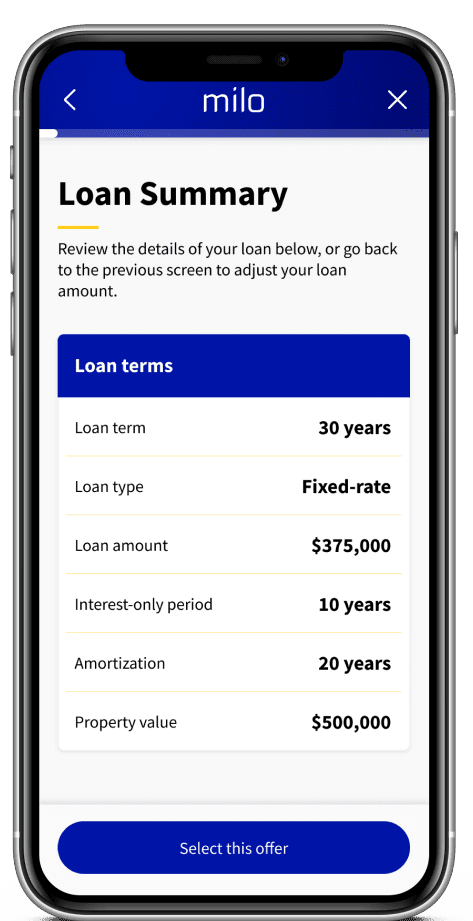
Milo’s mortgage structure is unconventional. Unlike traditional home loans, which require a downpayment and monthly principal payments, Milo finances up to 100% of the purchase price. Instead of selling Bitcoin to fund a home purchase – and triggering capital gains taxes – borrowers post an equivalent amount of Bitcoin as collateral. As long as they keep up with their payments, they retain ownership of both assets.
“It’s the first mortgage where the collateral can actually appreciate and help you pay down the loan,” Rupena noted. With Bitcoin’s recent surge, some customers have already used their gains to pay off loans early.
Interest rates remain a challenge, but Milo’s product is structured to be less sensitive to them. While traditional mortgage rates hover around 7%, Milo’s rates are slightly higher, in the 9% range. Still, Rupena argues that for many Bitcoin holders, the alternative (selling their crypto and losing potential upside) is far more costly. “We give them an option they wouldn’t otherwise have,” he said.
Looking ahead, Milo plans to expand its offerings, hire selectively, and strengthen relationships with capital partners. “We’re seeing a lot of customer interest,” Rupena asserted. “Now it’s about scaling to meet that demand.”
READ MORE IN REFRESH MIAMI:
- Milo’s $17 million Series A will help crypto investors make the most of their holdings
- Riding growth wave, Milo launches crypto loan product
- From construction finance to fintech, Kristine Viera is on a mission to transform the mortgage industry
- Will Miami’s crypto scene in 2025 be a new era or just more of the same?
- With $4B in real estate transactions under its belt, Propy continues to push the boundaries

- Emma Harris’ second act is off the wall - October 5, 2026
- doxx.net raises $38M to put AI agents on a shorter leash - October 1, 2026
- Jeeves raises $110M to take its stablecoin play global - September 30, 2026