


Derek Duzoglou, founder of D Squared, has spent the better part of two decades trying to get basic utilities to the people who need them most.
After earning his master’s in mechanical engineering from the University of Miami, he joined Bertram Yachts, a storied manufacturer operating just outside Miami International Airport. When the company folded during the 2009 downturn, he started his own consulting firm focused on sustainability, working at the municipal and commercial level before moving into large-scale waste-to-energy projects. What he kept running into was the same wall – high capital costs, complicated land acquisition, and project timelines that stretched for years. The communities that needed solutions most were exactly the ones the existing model couldn’t reach.
He went back to first principles. “How do we provide these types of solutions in a way that’s affordable, small scale, decentralized, and scalable?” The answer is Blue Current.
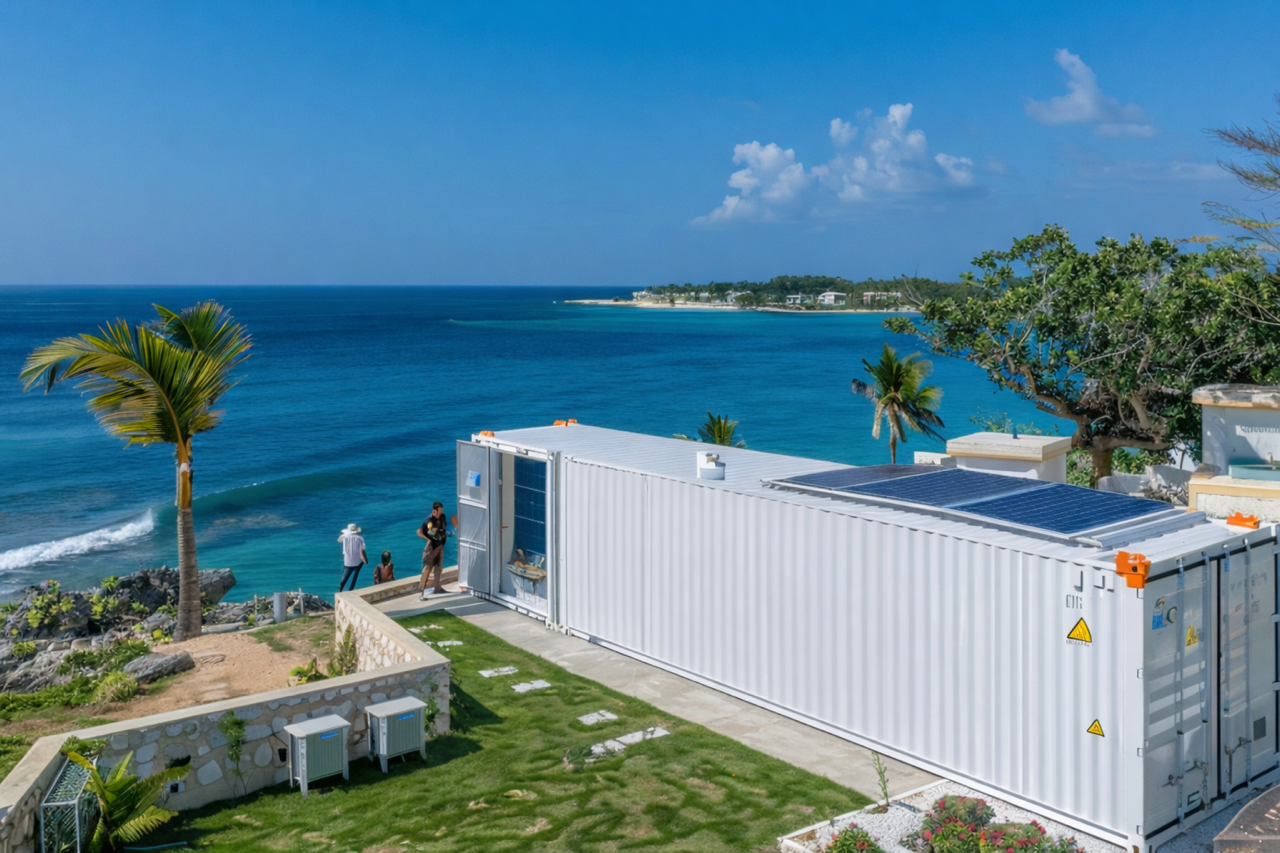
Blue Current is a line of containerized microgrids that fit power generation and water production into a single deployable unit. The entry-level pod is a 10-foot shipping container outfitted with solar panels, battery storage, inverters, and a water purification system. Depending on the water source available, it can run either a freshwater filtration system or a desalination unit drawing directly from the ocean. Nothing in it is proprietary. “We’re not reinventing the wheel,” Duzoglou says. “What’s unique is the way everything is being put together.”
The accordion-style solar panels fold inside and the container seals completely, which matters enormously for environments where a solar installation can be wiped out by a single storm. The design was also shaped by a logistical reality Duzoglou kept encountering in remote communities – large infrastructure doesn’t make sense if there’s no road wide enough to transport it. At 10 feet, a Blue Current pod can be moved by a small team without heavy machinery, and a unit can be built and deployed in roughly six weeks.
D Squared sees demand from two directions. The first is emergency response and disaster relief, particularly in South Florida, where hurricanes knock out power and clear bottled water off store shelves within hours. Local municipalities are a natural buyer. The second market is more philanthropic in structure. Rather than selling units to underserved communities that lack the resources to purchase them, D Squared is building a corporate sponsorship model. A company channels its corporate social responsibility budget into sponsoring a unit, which gets delivered to a specific school or village, with full documentation of what the system produces and who it serves. “We want those projects to be very specific,” Duzoglou says. “We want full transparency.”
The passion behind that model is personal. Duzoglou recalls visiting Jamaica as a kid, staying at a hotel where everything was provided, then walking around the perimeter wall with his father into the neighboring town. The kids there had two pairs of clothes and lived in houses built from scrap. “When you see that kind of disparity,” he says, “I think we have an obligation to help.” Power and water, he believes, are where that starts.
The geographic focus for initial deployments is the Caribbean, close enough to oversee directly and well-served by existing container shipping infrastructure. Other areas like Africa and Latin America could be on the longer horizon.
D Squared is a two-person operation, Derek and his father. Beyond the company, Duzoglou chairs the Sustainability Advisory Board for the Village of Key Biscayne and sits on the Industrial Advisory Board for the Department of Mechanical and Aerospace Engineering at the University of Miami, where he works to connect students with opportunities in the industries they want to enter. He watched many of his own classmates leave Miami after graduation simply because the jobs weren’t here.
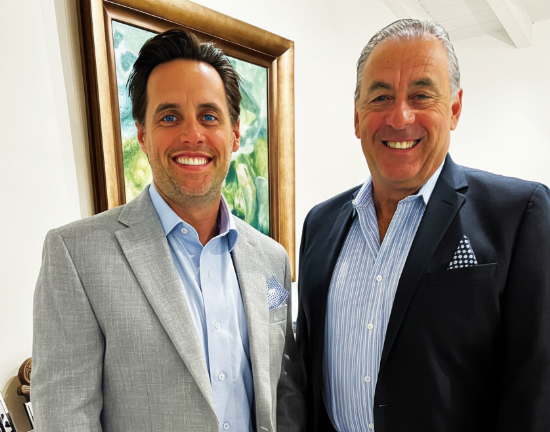
He thinks Miami is well-positioned to become what he calls a green tech hub, close to the Caribbean, increasingly attractive to technical talent, and already ground zero for the climate pressures that make resilience technology urgent. “To develop these technologies, conceptualize them, fabricate them, and deploy them all from here is ideal,” he says.
The company is currently seeking its first corporate sponsor to fund the build and deployment of an inaugural unit. That project, wherever it lands, will be the proof of concept everything else follows from.
READ MORE IN REFRESH MIAMI:
- How Coverfleet is modernizing trucking compliance
- E-Force Marine is building Miami’s first electric catamaran
- Mare Liberum raises fund to back the next era of maritime tech
