



Carlos Raúl still remembers the day insurance agents began knocking on EducUp’s digital door. What started as casual requests for onboarding lessons soon turned into a steady stream of demands for state-approved continuing-education courses – first in Florida, then well beyond.
“They kept asking for classes their agents needed to keep a license active,” Carlos Raúl told Refresh Miami. “That single request pushed us to rethink everything.”
EducUp had already made a name selling mobile language courses to 2.5 million Spanish-speaking learners. The product worked: retention was solid, revenue climbed, and the Miami-based team knew how to grow an audience on phones. But the inquiries from insurance and mental-health providers hinted at a much larger prize: a U.S. accreditation sector worth tens of billions of dollars and badly in need of modern tools.
Instead of treating the outreach as a one-off project, Raúl and his 22 teammates leaned in. They secured state approval to deliver life and health insurance credits in Florida, then applied for other jurisdictions one by one. Today the startup is authorized in 29 states and fully live in 18, with new approvals queued up every few weeks. Half of company revenue now comes from professional training, a line that did not exist a year ago.
The pivot gave EducUp something every subscription service wants: learners who must finish courses on a deadline. “Retention is no longer only about motivation,” Raúl said. “Agents and therapists need our classes to stay employed, so completion rates jumped right away.” He added that monthly recurring revenue has climbed steadily since the company replaced one-time payments with subscriptions seven months ago, and overall user growth remains healthy at forty- to fifty-thousand new sign-ups each month.
The accreditation push also led to fresh partnerships. CedrusMed, a South Florida-based electronic health-records platform, signed on to offer EducUp’s mental-health curriculum directly inside its software. That exposed the startup to thousands of social workers and therapists who count continuing training as an annual requirement.
“The integration with CedrusMed aims to make EducUp the preferred platform for mental health continuous education,” Raúl said.
Despite the momentum, the company maintains a lean structure: 23 employees spread across South Florida, Mexico, Panama, Chile, and Spain, with five founders anchoring Miami.
Looking ahead, EducUp plans to finish 2025 with approval in all 50 states, deepen its presence in mental health and insurance, and roll out a real-estate curriculum that covers both pre-licensing and renewal credits. Longer term, the roadmap includes accountants, teachers, any field where workers must prove ongoing competence. Raúl’s conviction is simple: “Accreditation software feels stuck in another decade. We’re bringing it up to speed.”
Funding strategy follows the same disciplined approach. The team aims to reach full profitability first, then weigh a larger raise once metrics support a higher valuation. For now, revenue covers expansion costs, and introductions to potential investors are welcome but not urgent.
As Raúl put it: “Our best leverage is growth we control.”
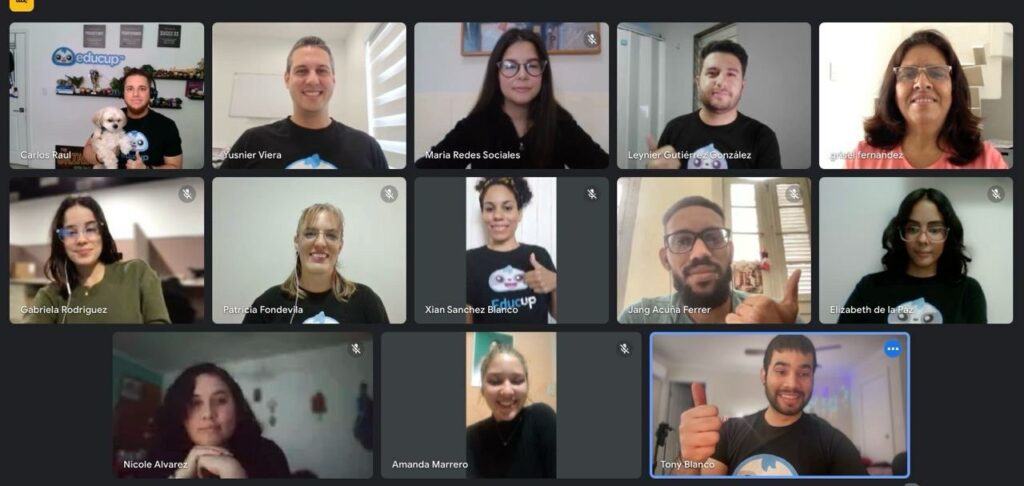
Pictured at the top of this post: EducUp co-founders, left to right, Yusnier Viera (CLO); Carlos Raúl (CEO); Yamel Barroso (CMO). Below: the EducUp Team.
READ MORE IN REFRESH MIAMI:
- Miami-based edtech startup TEDU raises $2M seed round
- Chilean-born EdTech expands to the US with Mati Barbero at the helm
- We’ve got the juicy details on one of Miami’s hottest edtech startups. AWS thinks so, too.
- Only up from here for EducUp, a rising star in Miami EdTech

- Terminal acquires Miami AI startup Stationed, plans to double team in Wynwood - October 22, 2026
- Vylit is giving creators a new way to find their fans - October 21, 2026
- Q Intelligence is taking a swing at Hollywood’s money problem - October 21, 2026