


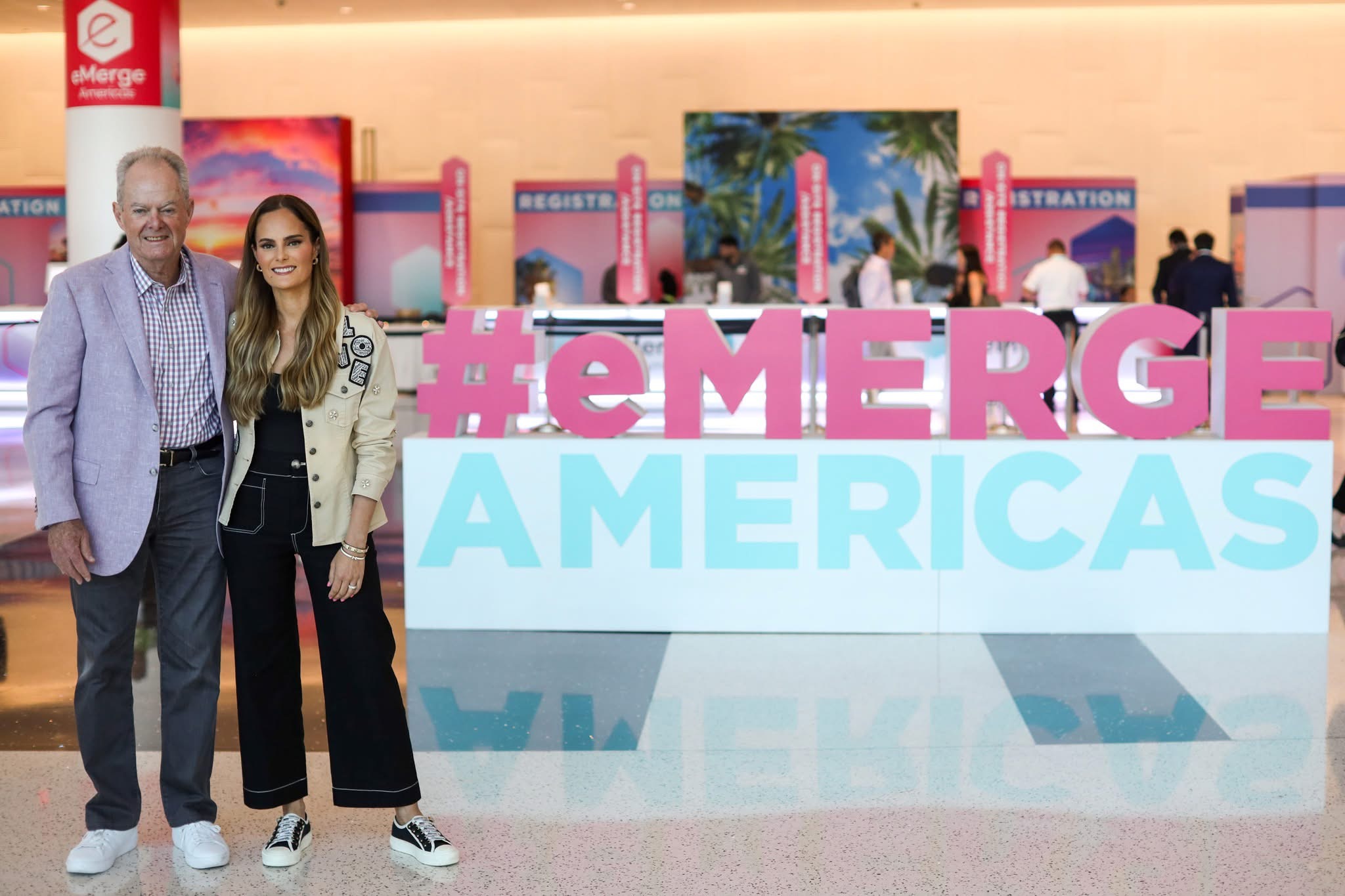
Day One featured Daymond John, Dave Portnoy, and heaping helpings of startup optimism and energy
By Nancy Dahlberg and Doreen Hemlock
Go big or go home – that could have been the eMerge Americas mantra as the Miami tech organization kicked off its 2025 signature conference at the Miami Beach Convention Center on Thursday.
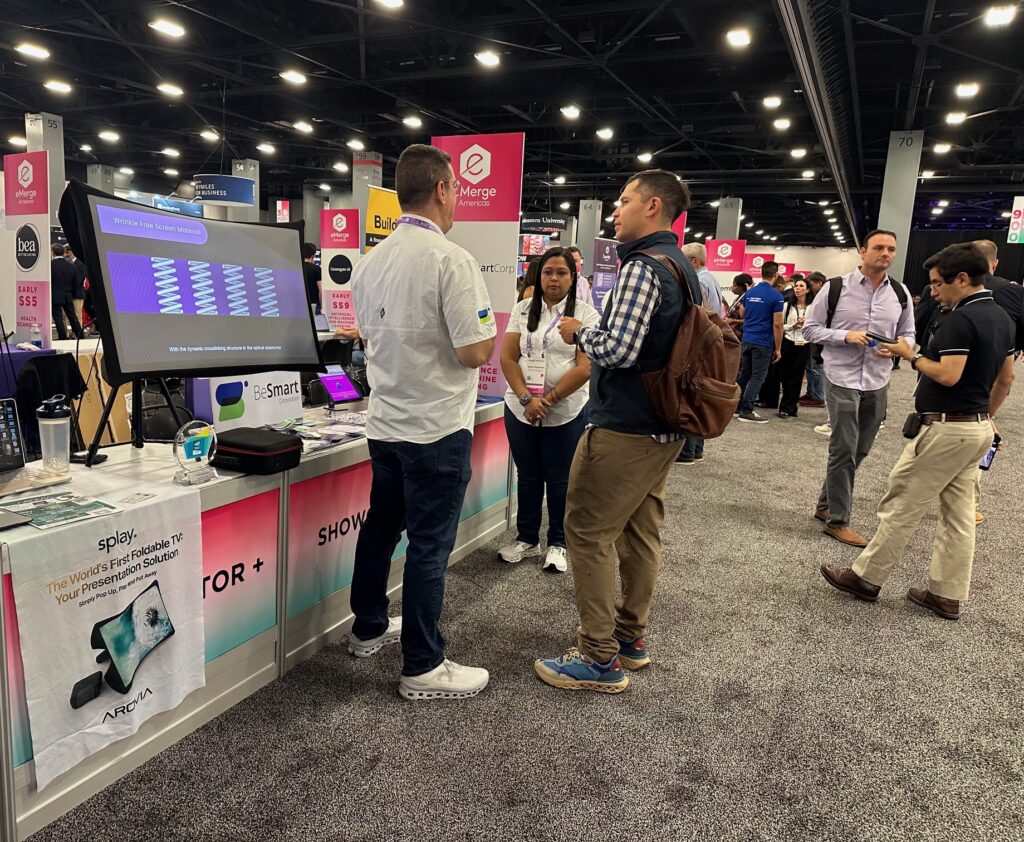
There were big pavilions for healthtech, AI and defense tech, which were part of a busy exhibition hall with over 300 exhibitors and seven stages featuring 240 speakers from around the globe. eMerge has always been international, but this year a record 60 countries were represented. What’s more, the VC LatAm Summit that brought together 300 investors from the region and the first-ever Israel Tech Week kicked off at the conference. As in past years, you couldn’t miss Startup Alley, right down the center of the exhibition hall, and there was a new area where small businesses could exhibit.
“For over a decade, our mission at eMerge Americas has been to help transform South Florida and Florida into a thriving global tech hub. We do this by convening entrepreneurs, investors, global tech execs, government and academia – and we do this throughout the year … culminating in this massive celebration,” said Melissa Medina, CEO of eMerge Americas, about the annual conference founded in 2014 by her father Manny Medina, a serial entrepreneur and one of the first to promote #MiamiTech’s potential.
We’ve gathered a few highlights of opening day:
Kicking off the day: Daymond John
After building the hip-hop clothing brand Fubu from a $40 investment into a multi-billion-dollar brand, Daymond John earned a massive following on the TV show Shark Tank, where he helped the Bombas clothing line grow into the show’s top revenue-producing venture to date. So, when John spoke Thursday morning, attendees packed the audience, eager to hear John’s personal experience, behind-the-scenes stories about Shark Tank and his advice for entrepreneurs.
John, a Miami area resident, said success comes to those who “get up before everybody and go to bed after everybody.” There’s opportunity everywhere: “Anything you buy, you can sell, and anything you can do for free, you can get paid for.” Businesses succeed when they “solve a problem or bring joy.” A venture launched just to make money typically fails. If you’re not “genuine” or not “in service” to others, people “will see right through you” and won’t partner or support you. Service involves steady feedback from customers to keep adding value for them, said John.
Investing in startups is not what it appears to be on the ABC show Shark Tank. While TV airs eight-minute segments, founders actually have one hour to pitch their ventures to sharks. With 16 cameras filming, those 16 hours of footage are condensed into scant minutes. Closing the deals often takes three to six months. The reality is that weighing and finalizing investments takes time, and for John, involves chemistry to really “like” a potential partner. “Trust your gut,” said John.
Artificial intelligence is revolutionizing business, yet John insists “human interaction is something tech can’t replace.” He suggests face-to-face contact with potential partners, especially because with AI and video-chats, you can’t be sure “is that even you talking to me?”
For audience member Cameron Gholami, a vice president at engine-fluid delivery venture Zulu Pods, John’s talk was inspiring, underscoring that success flows from “focusing on solving a problem and unwavering commitment to your customers.”

Transforming healthcare
Ten years ago, serial entrepreneur, lawyer and author Martine Rothblatt spoke at eMerge Americas and set an ambitious goal for the next decade: to modify the genes of pig organs, so those organs could be transplanted into humans, and people would not die waiting for human organs. Her venture, United Therapeutics, has done and keeps refining the process.
Now, Rothblatt has a new goal for the next 10 years: to develop new human organs using stem cells with a person’s own genes “to create an unlimited supply of transplantable human organs.” Her venture works partly through 3D computer models in what’s called computational biology.
For Rothblatt, “persistence is omnipotence,” that is, experimenting over and over eventually produces powerful discoveries that can spread everywhere, like smartphones. Think of the word impossible, and “imagine an ax slashing through the M and the P, and saying I’m possible,” she said.
Rothblatt first made a name in satellite communications as founder of SiriusXM Satellite Radio and CEO of GeoStar. She pursued pharmaceuticals after her child was diagnosed with a rare pulmonary disease. She’s also helped develop electric helicopters to speed delivery of organs for transplant. Her advice to students: pursue more areas of knowledge, from engineering to history, social sciences to art, because interdisciplinary approaches spur discoveries. “Cross borders, respect everyone, and look for the intersections,” Rothblatt told eMerge.
AI and quantum experts draw big crowds
Perhaps not surprisingly, AI was once again a running theme throughout most of the talks.
Matthew and Michael Vega Sanz, Miami natives and twin brothers, discussed their journey from founding Lula Rides, a car-sharing business on college campuses, to Lula, an insurance platform, to now creating Gail, AI for financial services. “Someone’s going to bring AI to the world of financial services or insurance or insurance or banking – why not us?,” said Matthew, and they went all-in last year on what they believe is a massive opportunity.
Already, Gail speaks 50-plus languages and handles 800,000 to a million daily conversations. The AI is used by 240 companies across four countries, including four major US insurance agencies and three large banks, and the brothers are hoping that Gail will one day show the world that a multi-billion or trillion-dollar company can be built in Miami, the brothers told the crowd from the LaunchPad stage.

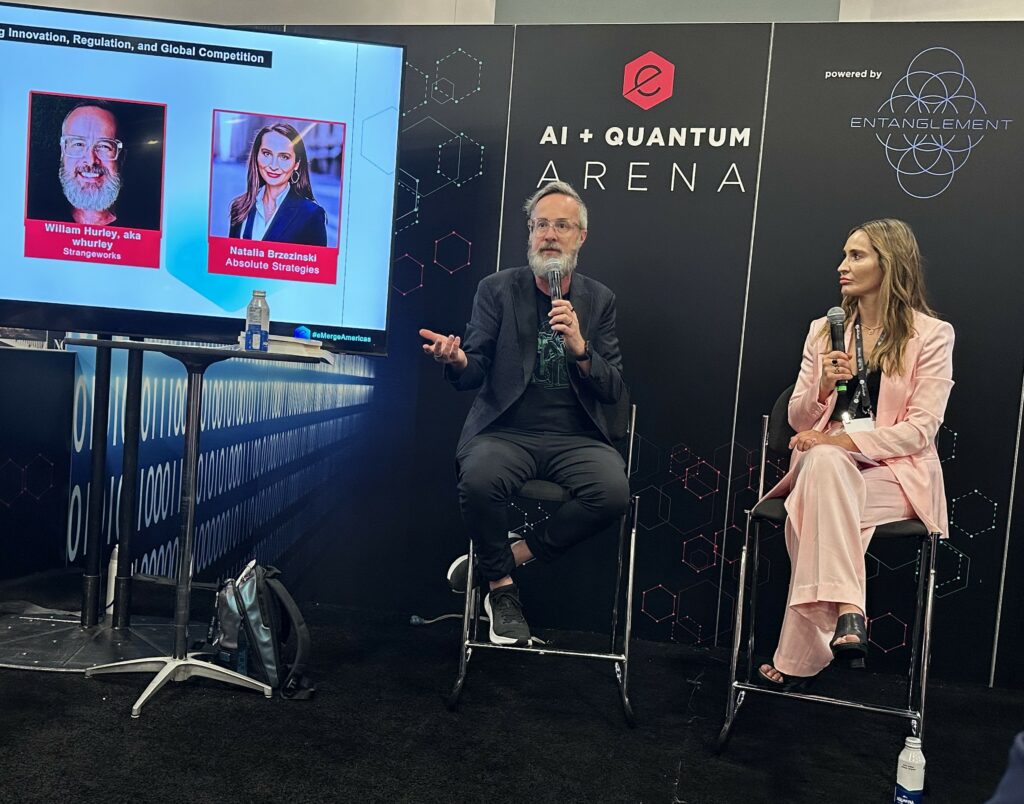
The Quantum & AI hub was the place to be, judging by the crowds gathered for the speakers. William Hurley (aka whurley), a quantum expert, author and founder of StrangeWorks, gave a talk that was both inspirational and terrifying at the same time. Inspirational because as quantum computing advances there’s no limit to the big problems it can solve for humankind – like eliminating a disease, he said. Terrifying because whether you are an Uber driver, a software engineer, or in many other professions, your job will go away and there could be massive unemployment.
“I would encourage everybody to use every single tool you can to experiment and learn. The world is going to belong to the people who understand how to utilize this and are not afraid of it,” he said, also adding that there needs to be collaboration between the people building the future and the people who will be living in that future.
New technologies bring out bad actors too, he said, and that’s another reason why the world needs more good people involved in the field. Speaking to a student in the audience, he said, “there’s going to be an entire technological revolution and it’s going to be your world and it’s going to be absolutely amazing.”
And there was a lot of Miami talk, too
Many of the discussions on the seven stages focused on how Florida and the Miami area are prepared – or preparing – for what’s ahead. Florida Atlantic University’s new president, Adam Hasner, in a discussion with Greenberg Traurig’s Jaret Davis and Manny Medina, an FAU and Miami Dade College alum, emphasized the importance of partnerships between Florida’s universities and industry to create innovation and prepare students for future careers. As for what’s ahead for South Florida – a region Davis says is becoming the nexus point to the world – Medina hopes the region will become a hub for AI and quantum, leveraging its universities and research institutions.
On the lighter side, in a keynote talk closing the day, Dave Portnoy, founder of the highly popular and influential media brand Barstool Sports and a Miami resident, revealed that he would have moved his company’s headquarters here if it wasn’t for the weather and the nightlife. It’s too distracting. “I want my guys in the office working, not at 11 or 12 partying. … Fix that and it’s perfect,” Portnoy said about the Magic City. He also praised Miami for being a city where “everyone’s trying to make their mark.”
Most of Portnoy’s team has been with him for 20 years. “We want to build them into stars… I want all our people to be successful, I really do, it means we’re successful,” he said in an on-stage conversation with Miami Mayor Francis Suarez. Oh, and by the way, Portnoy, who got his start with pizza reviews, says Miami is a pretty good pizza town too.

eMerge Americas returns Friday with day two of the conference (Reading this report later? Find our day 2 coverage here). Highlights will likely include keynote talks by Armando Christian Perez (aka Pitbull), Palmer Luckey and Stephen Ross as well as the grand finale of the Startup Showcase, where five finalists will pitch live on the main stage for a chance to win a $125,000 investment.
READ MORE IN REFRESH MIAMI:
- Miami metro’s startups raised $2.77B in 2024, ranking South Florida as a top 10 VC hub, eMerge Insights finds
- First-ever Israel Tech Week in Miami debuts, starting at eMerge Americas
- Miami’s women in VC are rewriting the investment playbook
- Fundings of female-founded startups rose in South Florida last year. Who raised the most and what are the trends?
- French Tech Miami is helping startups find their raison d’être in Miami
- Miami-Dade bets on startups to fix our solid waste problem
- Up, up, up: South Florida on way to another strong VC year, PitchBook’s Q3 report shows - October 8, 2026
- 8+ things to know in #MiamiTech: Mana Tech to launch Tech Cities of America; FAU reels in quantum grant; plus news from Global Ventures, HighPost Capital, PlanHub, Calculum, job opportunities & more - October 7, 2026
- 10+ things to know in #MiamiTech: News about Ondas, Visium, Misfit Labs, OBE Power, The Xtream Group, Stephen Ross, Blue Frontier, Zeo Scientifix & more - September 27, 2026