



The future of tech is in the hands of those who build it. This week’s Infobip Shift Conference was a celebration of developers and their impact, as well as a key learning and networking opportunity for them.
The 2025 Infobip Shift Miami Conference, back for its year 3 in the Magic City, is a leading developer-first conference. The global conference, founded in Croatia, was held this week at Perez Art Museum Miami and The LAB Miami and attracted a full house, it’s largest attendance in Miami yet.
“Miami is feeling a bit more like home,” said Ethan Gustav, Group President of North America for Infobip, Croatia’s first unicorn. “It’s also a very important growth area for our business. We make bringing communications at scale into your applications easy, and you can do that with our platform. A lot of startups have scaled their businesses very significantly — today they are some of the largest technology companies and brands on the planet – and who knows one of them might be you some day,” he told the developers in the crowd. One of the company’s interesting offerings is Infobip Startup Tribe, a perks program with no contractual obligations and over 700 startup members (and counting) globally.
Perhaps not surprisingly for the 2025 edition of the conference May 5-7, the focus was AI, including the dev tools now available, AI’s impact, use cases, security concerns and more. But the real aim of the conference, said Infobip co-founder and CTO Izabel Jelinic, is to learn together. “Let’s all become better engineers through the power of AI.”
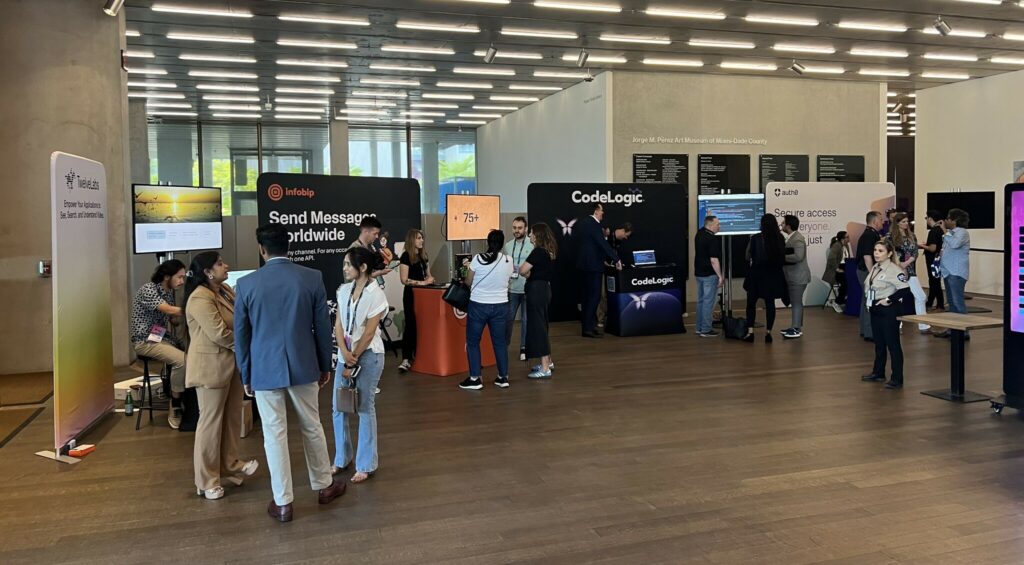
As a developer-first conference with about 700 people registered to attend, much of the content was highly technical, but broad themes for the general audience also emerged. Here are six things we learned at Shift Miami 2025:
1: Meet your AI teammates, lots of them
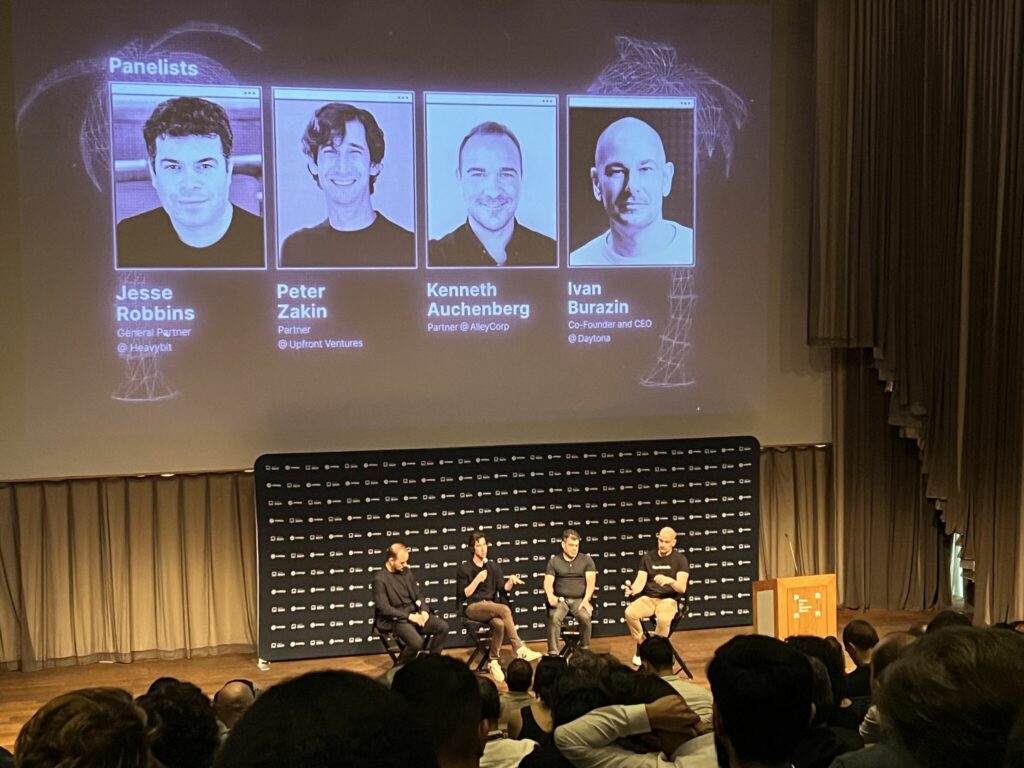
The hybrid world of software engineering teams always being a mix of engineers and AI agents may be just around the corner. It could even be one human to 10 AI agents. “Every single software engineer is going to use a lot of different verticalized agents to get the job done. Think of the human as the fleet general,” said Kenneth Auchenberg, partner at AlleyCorp. “Delegation is the new automation,” agrees Jesse Robbins, general partner at Heavybit. In another session, Robert Brennan of Open Hands said anything a software developer can do, an AI agent can do. Brennan’s advice for those developers getting started with AI: Start small, give clear instructions and, most importantly, always review the code.
2: AI is quickly becoming a coder of choice, even at the largest tech companies.
It’s been recently reported that Microsoft is now using AI for 30% of its coding, Google is over 30% now, and a quarter of the latest batch of YC founders are using AI for 95% of their coding. “I think that number is going to go up a lot… and I think we are still going to need to be able to understand how the code executes what it’s doing” and that could require even broader computer science skills, said Edwin Gnichtel, CEO of CodeLogic, who spoke about tech debt in the age of AI. An audience member asked: Knowing what you are doing comes from experience writing code, so how are people new to the industry going to understand what’s happening with the code? That’s a big question, said GnichtelI. “How do we keep ourselves from atrophying and becoming like that civilization in Star Trek, The Next Generation, that lost all track of how their technology works? We better not, otherwise we will be in really big trouble. That’s my unsatisfactory answer to that question.”
3: Every developer should build their own agent.
Morgante Pell, founder of Grit, spoke about moving past one-off AI prompts and creating a level 3 or 4 fully interactive and scalable coding agent. “It’s actually really simple. Everyone who’s a developer with a little bit of experience can do it,” he said about creating an AI agent from scratch that everyone should do at least once. In about 20 minutes, he explained the process. “You can probably build a pretty simple one in a few hours, and can build the basics of all the components in an afternoon or weekend project.”
4: Expect the world of material science to be disrupted with multimodal applications
Using a few live demos, Stefania Druga, research scientist at Google DeepMind, explored the world of multimodal applications that see, hear and interact with the world in real-time. Expect the space of material science to be highly disrupted with the new multimodal apps. Expect to see 3D design accelerated in areas like heritage preservation, including for rare languages, she said. The future of real-time multimodal AI applications can be seen in personalized assistance, robotics, accessibility tools, creative collaborative tools, truly adaptive education, and deeper human-AI collaboration, added Druga [pictured at the top of this post].
5: Today is the best time to be a builder
In just three years, programming has gone from almost everything manual to much by natural language commands and agentic capabilities. Prompting is the new programming, says Aadit Sheth, founder of Prompt Daily and an AI researcher, who discussed the leading tools out there, including showing chain of thought reasoning to get the most out of your prompts. Try all of the coding agents and evaluate the responses, he says. Though the most expensive, he finds Devin the closest thing to a true agentic coding experience that he’s seen. His advice on staying up to date: Follow builders on podcasts and the best way to learn is by doing. It’s the best time to be a developer, he adds: “AI is a skill that will make you a better engineer. AI is not going to be able to solve all the problems in the world – humans will still be able to do that.”
6: COBOL is still alive and well, but AI can help with that.
COBOL was the solution of choice 50 years ago, but there’s still a lot of mainframe and COBOL workload and applications out there, particularly in banking and finance companies and airlines. That’s because it’s really hard to move into the Cloud because the projects at banks and airlines are huge, like 80 million lines of monolithic COBAL, says Louis Knight Webb, co-founder and CEO of Bloop. “It’s an exciting problem to work on because it’s one of those most boring developer tasks on Earth. And that is exactly what AI is supposed to do, free us from the boring stuff. We’re aiming for fully automated conversion (from COBOL to Java),” said Webb, who talked through their journey of experimentation to find a way to do this.
COBOL also had a starring role closing out the first day of the two-day conference. A startup pitch competition focused on AI and put on by Startup Grind. Competing were Spark Founders, an AI-driven cofounder matching platform; Employers for Change, which leverages AI to streamline internship hiring and beyond; Easy Champ, an AI-powered platform for sports and esports management; and COBOL Pro which uses AI to modernize legacy COBOL systems. The winner was … (drum roll please) … COBOL Pro, co-founded by Juan Lucas Barbier, CEO, and Jugo Angel, CTO.
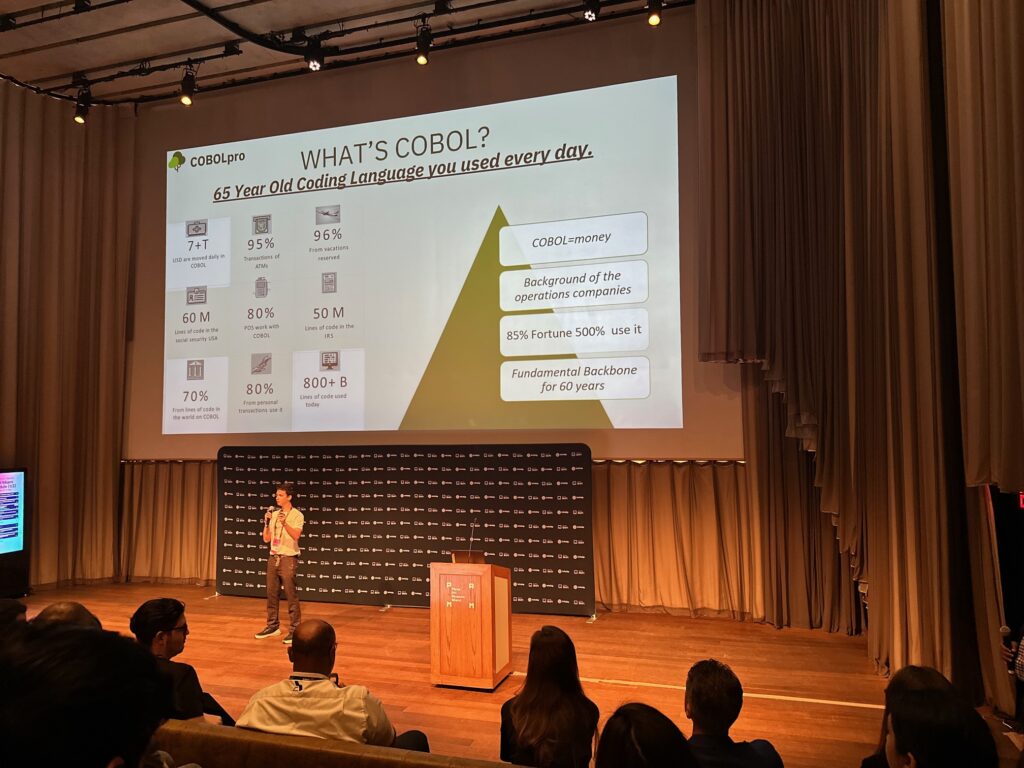
Pitch competition winner Juan Lucas Barbier, CEO of COBOL Pro.
The second full day of the conference, held at The LAB Miami May 7, was all about bringing your own laptop and getting hands-on with the learnings from Day 1 in workshops and through networking. There was also plenty of networking going on during Shift’s pre-event gathering in Brickell on May 5th and the conference’s after-party at Miami World Center on May 6.
In great news for the Miami area’s growing developer community, the Infobip Shift conference is planning to return in 2026 for a year 4 in Miami, and the team hopes to make this developer-first conference an annual event. Stay tuned for the date. The conference also will take place in Zadar, Croatia, Sept. 14-16, 2025.


READ MORE IN REFRESH MIAMI:
- Blumberg Capital is bullish on #MiamiTech: Q&A with founder David Blumberg
- What’s POSSIBLE: Inside the conference where AI, attention and impact collide
- Endeavor Miami announces a strategic relaunch of its ScaleUp program and the next cohort. Let’s meet them
- CodePath expands at FIU with a new for-credit curriculum and more. What’s ahead?
- Miami area startups raised $900M in Q1, Pitchbook report says. Here are the top deals.

- From Miami to the World: How a Miami 16-year-old is scaling access to tech education - October 15, 2026
- MDIA lands $3M Knight Foundation investment to expand its innovation model nationwide - October 14, 2026
- Ambition Accelerated kicks off statewide accelerator in key sectors. Here are the 19 South Florida startups selected - October 13, 2026