


The AI economy is accelerating. What do we need to do to keep pace with the country’s fastest movers?
The latest Brookings report on AI doesn’t bury the lede: the vast majority of U.S. cities aren’t ready for the next tech wave.
Just two metro areas (San Francisco and San Jose) were responsible for 13% of all AI job postings in 2023. The message? When it comes to artificial intelligence, the rich are getting richer – and most cities are just watching from the sidelines.
Miami? Not so much. We’re in the “Star Hubs” tier, one level below the Bay Area’s dominant “Superstars.”
That’s not a participation trophy. Out of nearly 400 U.S. metro areas, just 28 made the Star Hub cut. And Miami is one of them.
So what does that mean, exactly? According to this report, Mapping the AI economy: Which regions are ready for the next technological leap?, Star Hubs are regions showing real strength across all three pillars of AI growth: talent, innovation, and adoption. Miami, one of the fastest-growing metros for AI job postings, is not dominating the charts like the Bay Area (yet!), but we’ve got enough momentum and infrastructure to matter in the national picture.
Still, Brookings researchers Mark Muro and Shriya Methkupally make it clear: Staying in that second tier isn’t the goal. The gap between the Superstars and everyone else is growing. If cities like Miami want to close it, we need to act both fast and smart.
The Brookings playbook is clear. And Miami seems to be reading it.
Beyond its rankings, Brookings offers a roadmap for how Star Hub cities can boost their AI capacity. Here’s how Miami stacks up.
1. Talent: Miami’s pipeline is still early-stage, but growing
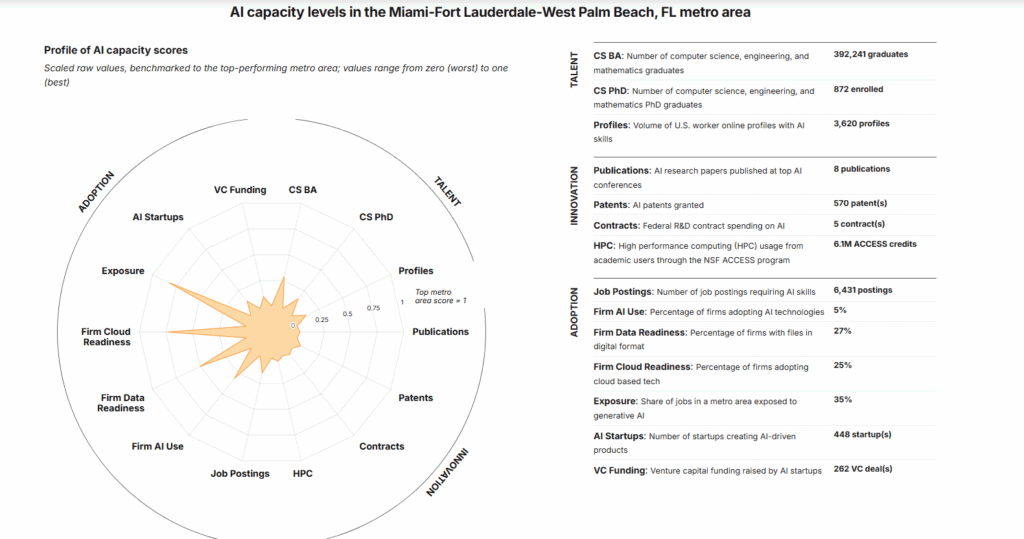
Muro shared with Refresh Miami that our region has around 3,620 AI-skilled profiles: a small number compared to top tech hubs. The number of PhD grads in CS/engineering? Just 872 enrolled. Not nothing, but not enough either.
Brookings emphasizes the need to expand local training, not just in academia, but in workforce and community settings. That’s where efforts like the Miami AI Hub come in. Now part of eMerge Americas, it’s designed to get more people building, using, and understanding AI, whether they’re product managers, creatives, or early-career engineers.
It’s not Stanford. But it’s local, applied, and growing, which is exactly what Brookings encourages.
2. Innovation: Less ivory tower, more real-world solutions
According to Muro and Methkupally, Miami logged 570 AI-related patents, 5 federal R&D contracts, and just 8 academic publications in top AI journals. That puts it behind many research-heavy metros. But innovation doesn’t just mean papers.
High-profile, global startups like Cast AI (which just raised $108 million to make cloud infrastructure more efficient for AI workloads) and Exowatt (which, in April, raised $70 million to power AI data centers with clean thermal energy) are tackling big, technical problems – and building real businesses in the process.
Brookings flags the importance of commercial innovation, especially for cities without elite research institutions. That’s exactly the lane Miami is in.
3. Adoption: A city where AI is starting to show up in everyday work
Miami has some of the highest AI exposure in the country: 35% of local jobs are in occupations likely to be affected by AI. That’s a key stat Brookings tracks and a sign that this isn’t just a niche trend in the region.
Meanwhile, 448 local startups are working on AI-driven products. Among them:
- Gail, which raised $8.2 million to build an AI advisor for regulated financial sectors
- Pelico, which secured $40 million to scale the next generation of supply chain AI
- FirmPilot, which leverages AI to help legal firms more effectively market their services
- And over 100 (and counting!) that Refresh Miami has covered
Brookings stresses that “adoption” is one of the hardest metrics to improve, but also one of the most critical. Miami’s startup scene is helping push that forward, not just through products but by getting AI into more sectors: finance, nonprofits, infrastructure, and beyond.
So, where does Miami go from here?
Brookings makes it clear that staying in the Star Hubs tier will take more than good intentions. It requires ongoing investment in training – not just through universities, but also through community programs and industry-led efforts.
It also means building out shared infrastructure, like access to high-performance computing or affordable cloud resources for startups. Just as important is driving real-world adoption of AI across sectors like healthcare, logistics, and public services.
And finally, it calls for stronger collaboration between universities, startups, and civic leaders to ensure that innovation doesn’t happen in silos.
Miami’s not a tech underdog anymore, but we’re also not a frontrunner. The challenge now is to prove that a city can build a lasting AI economy without just trying to copy Silicon Valley.
And if any city’s up for that kind of reinvention, it’s probably this one.
Download the full Brookings report here.

Nancy Dahlberg contributed to this report.
READ MORE IN REFRESH MIAMI:
- eMerge Americas acquires Miami AI Hub and doubles down with new chief AI officer and Miami AI School
- Miami startup Gail secures $8.2M to build the AI-powered brain of financial services
- Pelico raises $40M to scale the next generation of supply chain AI, all from new base in Miami
- Cast AI turned cloud chaos into opportunity, and just raised $108M to do even more
- Exowatt secures $70M Series A to help solve AI’s big power problem
- FirmPilot adds Reuters and HubSpot to cap table as it leverages AI to rewrite the rules of legal marketing

- Dapta raises $6M to give Main Street businesses an AI advantage - October 13, 2026
- David Blumberg on why Miami’s tech moment is still gaining ground - October 13, 2026
- This Miami startup thinks your home should have a signature scent - October 12, 2026