



Global startup leaders assert that the future isn’t in Silicon Valley
On Wednesday, Endeavor Miami brought a different kind of founder conversation to Miami Beach.
Its Endeavor Summit 2026 leaned into the idea that some of the most interesting companies today are being built outside traditional tech hubs.
“We were tired of innovation only being talked about in two places: Silicon Valley or China,” said Endeavor co-founder and CEO Linda Rottenberg in a recorded message. “What we see is that talent is everywhere. Innovation can come from anywhere. The future is elsewhere.”
For Miami, that idea lands at the right moment. The city has spent the last few years positioning itself as a bridge between ecosystems, and this event leaned directly into that role.
Miami as a hub, not a backdrop
If the video set the global stage, Claudia Duran, Endeavor’s regional managing director for North America & managing director of Endeavor Miami, brought it back to the room.
“Welcome to Miami, the Magic City, where anything is possible,” she said.
More than 80 entrepreneurs from 30 countries were in attendance, a mix that reflected the summit’s core idea of engaging directly with other founders navigating similar challenges in very different markets.
“This event is for you,” Duran told the audience. “The magic of Endeavor happens when entrepreneurs come together and connect.”
Building in tough markets, scaling anyway
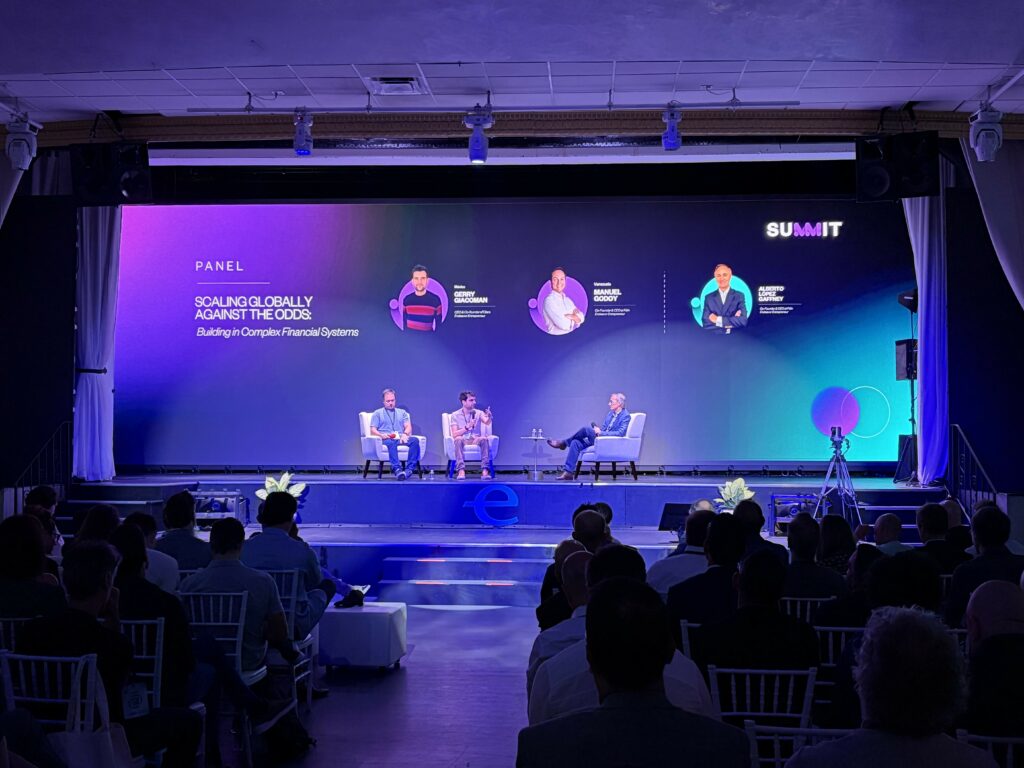
That idea came into focus early in the session on scaling across complex financial systems.
Founders such as Gerry Giacomán Colyer of Clara and Manuel Godoy of Félix spoke about what it actually takes to build in markets where infrastructure is uneven and trust has to be earned.
For Godoy, the starting point was behavioral, not technical.
“We had to build something that emulated that human experience… while enabling the convenience of digital,” he said, explaining why Félix built its remittance product directly on WhatsApp.
That focus on user behavior showed up early.
“What made me convinced that we were up to something was when looking at our users being marveled at the product in those early days,” Godoy said. “I remember our first user. She was skeptical at first. But when she confirmed the money had arrived to her family, she was amazed, and then she became an ambassador.”
“To me, the essence is understanding that the user is really appreciating the product so much that they cannot leave it,” he added.
As Félix expanded, that insight shaped how they approached new markets.
“What we understood is: who is our user? And how do we grow by focusing on users that are very similar to that first one,” Godoy explained.
Across the panel, the takeaway was consistent: companies built in more complex environments tend to scale with a different kind of discipline.
Fintech is moving faster than the rules
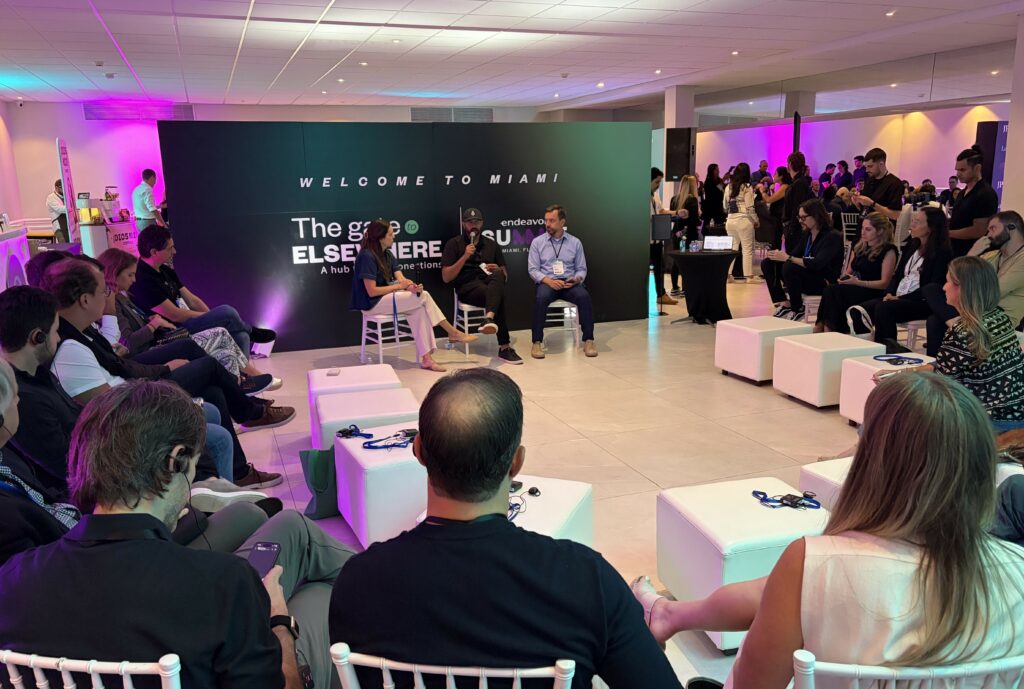
That tension – between innovation and infrastructure – came up again in a later breakout on fintech.
For Dileep Thazhmon of Jeeves, the shift is already underway.
“Stablecoins, like many things, are becoming a commodity,” he said in a breakout session. “CFOs don’t care if it’s a stablecoin or not. They care that it works better.”
In other words, the underlying technology is fading into the background. What matters is performance. That mindset is shaping how Jeeves is building and expanding, including a planned launch in Argentina.
At the same time, Thazhmon pointed to another layer of change happening inside companies themselves: how AI is being deployed operationally.
“Internally, you have to make a conscious effort to push AI,” he said. That includes rethinking how teams are structured. “We don’t have a CTO. Both VPs of Engineering report directly to me,” he said, describing a flatter model that allows faster decision-making.
On the product side, the approach is increasingly modular.
“We’ve broken things up into agents that take on specific tasks,” he explained, pointing to use cases like processing thousands of transactions tied to general ledger coding.
Looking ahead, Thazhmon sees stablecoins and AI converging in a more practical way.
“Stablecoins lend themselves cleanly for agentic spending,” said Thazhmon [pictured below in center], meaning systems where software can make and execute financial decisions with a level of trust that didn’t exist before.
AI moves from hype to application
That theme carried into other sessions as well.
In the infrastructure-focused conversation, operators like Yuri Frayman of Cast AI and Antoine Jebara of JumpCloud focused on efficiency, cost, and control – the less flashy, but more durable side of the AI wave.
Later, in breakout sessions, founders like Hovhannes Avoyan of video producing platform Picsart shared how AI is being embedded into products in ways that actually change how users interact with them.
“Gen Zs really value our fast models,” he said. “A few seconds delay, for them, is a big deal.” He said that AI is progressing fast. At presentations, he often puts up four photos and asks audiences to choose what’s AI. “99 percent of people guess wrong.” Soon AI video production will be better too. “AI video by the end of the year will replace lots of human production.”
Miami native Matthew Vega-Sanz, cofounder and CEO of Gail, noted that AI agents focus on specific industries and offer depth of knowledge. “Companies should treat AI agents like an employee,” he asserted. “Start off with one specific task, then add more.”
The gap is widening between companies experimenting with AI and those building around it.
The hard part: turning traction into systems
Another thread running through the summit was what happens after early traction.
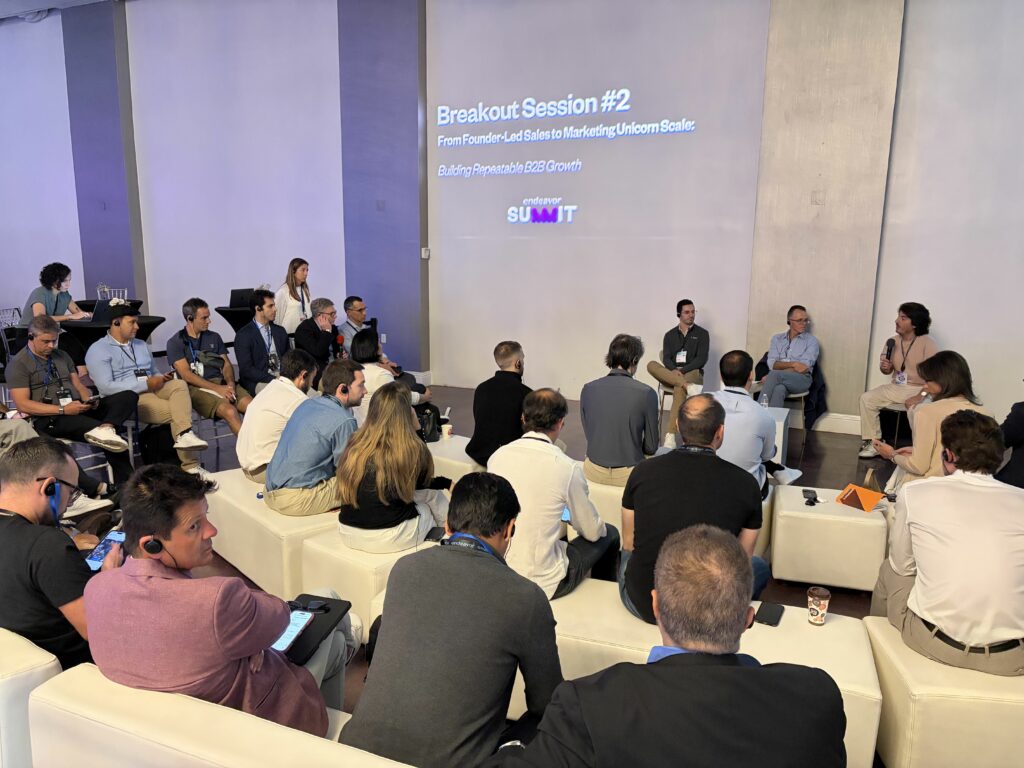
Sessions on go-to-market and growth brought in operators like David Bitton of DoorLoop, who spoke about the shift from founder-led sales to something repeatable. What works early on – speed, intuition, direct founder involvement – doesn’t always scale. Building systems becomes unavoidable.
Bitton also told Refresh Miami that the company, which currently has 250 employees, is likely stepping back from expanding its footprint and instead focusing on creating AI-driven efficiencies.
At the same time, conversations around burnout pointed to a more honest view of what it takes to sustain that pace, with OnTop co-founder and CEO Julian Torres and Booksy co-founder and CEO Stefan Batory addressing the tradeoffs behind high performance.
From product to brand
By late afternoon, the focus shifted again, this time toward identity.
Erica Groussman of TRUBAR and veteran marketing executive Arturo Núñez explored how companies move from building functional products to building brands that people actually connect with.
The bottom line: Product features can be copied, but brands are harder to replicate.
From “Elsewhere” to everywhere
The day closed with a session that tied the theme together.
Martín Migoya of Globant and EBANX co-founder and CEO João Del Valle returned to the idea that companies built outside traditional hubs are no longer exceptions – they’re becoming the model.
For a city that sits between Latin America, the U.S., and Europe, that perspective is far from theoretical. In fact, it’s already happening.
Pictured at the top of this post: Endeavor Entrepreneur Johanna Mikkola was the Summit’s MC.
Doreen Hemlock contributed to this report.
READ MORE IN REFRESH MIAMI:
- Jeeves serves up fintech innovation, enabling capital to flow at a global scale
- Miami wants to be the bridge, and Startup Olé made the case
- Cast AI is tackling the $30 million problem sitting idle in your cloud
- The AI wave is forcing a reset in Miami’s tech training. 4Geeks is on it.
- National Security Demo Day a salute to the power of tech and innovation
- Israel Tech Week Miami set for second year, bigger with more tech sectors

- Can Bitcoin solve the broken homebuying math? Milo thinks it can - October 6, 2026
- Emma Harris’ second act is off the wall - October 5, 2026
- doxx.net raises $38M to put AI agents on a shorter leash - October 1, 2026