



By Anayansy Hernandez
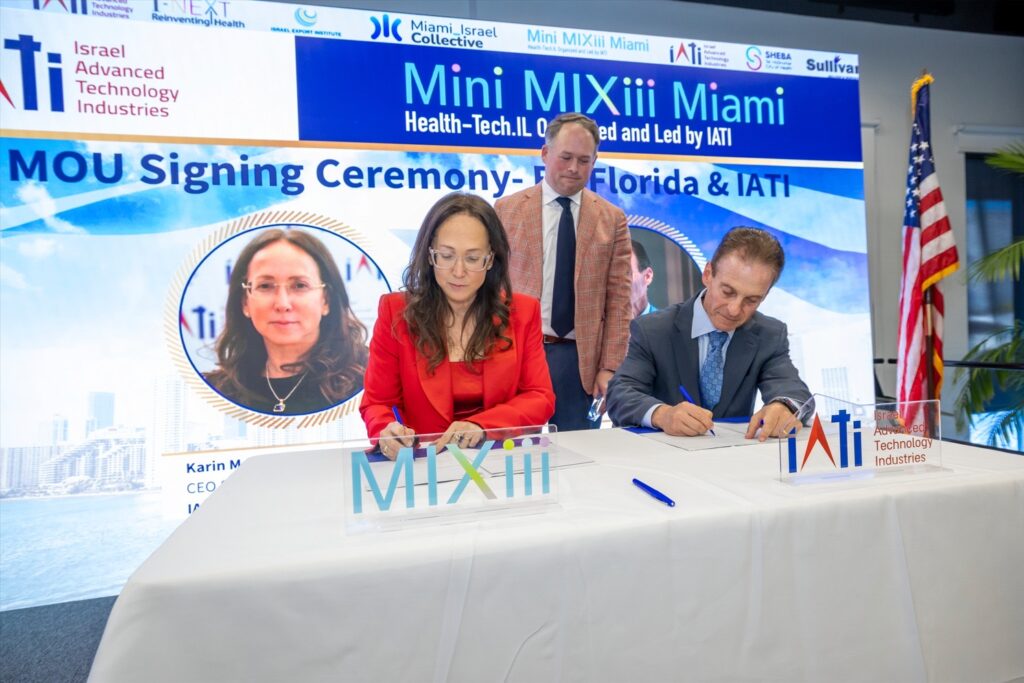
Florida’s Healthcare Administration Secretary Jason Weida oversaw the signing of a Memorandum of Understanding between BioFlorida and the Israel Advanced Technology Industries Association (IATI). The agreement, signed during the first-ever IATI Mini MIXiii Miami 2025 healthcare technology conference last week, represents a significant milestone in fostering collaboration between Florida and Israel’s health-tech and life sciences sectors. At The LAB Miami in Wynwood, more than 200 attendees joined the conference to discuss current collaborations and success stories in the healthcare ecosystem between both tech hubs.
Conference speakers emphasized the strengthening alliance between Israel and Miami, positioning the city as a pivotal hub for Israeli startups seeking to expand into theUnited States market. “As an Israeli, I feel a lot of support in Miami. We did our research and identified Miami and South Florida as a place Israelis still have to explore,” said IATI CEO Karin Mayer Rubinstein. Mayer believes creating connections between Miami’s hospitals, universities and investors is crucial for establishing long-term partnerships that can drive sustainable collaborative efforts. Secretary Alex Kelly from the Florida Department of Commerce described the business relationship and mission between both areas as being “one in the same.”
Why Now? Speakers shared insights on why others should invest in Israel
Speakers made a compelling case for why now is an opportune time to invest in Israeli startups, citing the country’s thriving innovation ecosystem and unprecedented potential for growth. According to Thomas Nides, vice chairman of Blackstone, Israel increased economic growth during its third quarter by 3% and Israeli tech companies raised over $8 billion in venture capital in 2024. Currently, the region is home to approximately 1,800 health tech companies, which comprise a substantial 23% of the total startup ecosystem.
Nides said he is “exceptionally bullish on Israel.” According to him, Israel’s safety has improved despite its complex political landscape, and he’s optimistic about the country’s economic prospects, expecting growth to persist into 2025. This outlook aligns with projections from the Bank of Israel, which forecasts a 4% economic growth rate for 2025, followed by 4.5% in 2026.
Startups strengthened the sentiment that Israel is ready to be invested in
As the conference drew to a close, 18 startups joined the stage to showcase their latest health developments. Aidoc CEO Elad Walach, based in Miami, introduced his startup, an artificial intelligence operating system that enables clinicians to work more efficiently by consolidating data, enhancing communication, and facilitating rapid, informed decision-making. In radiology, for example, the system can notify radiologists of suspected positive cases and immediately provide specialists access to critical clinical information.

Momentis Surgical, with a wholly owned subsidiary in South Florida, shared its mission to empower surgeons to perform minimally invasive procedures. The Anovo System is the first FDA-authorized robot that features miniature humanoid-shaped arms that mimic a surgeon’s precise movements. As referenced on their website, the system costs significantly less than conventional robotic systems and offers patients the benefits of less invasive robotic surgery.
Another company crossing AI with healthcare was Tel Aviv startup AISAP. Its Point-of-Care Assisted Diagnosis, POCAD, is an AI-powered ultrasound diagnostics system that makes it faster and simpler to diagnose patients. POCAD can provide immediate interpretation of an image, connect the appropriate care teams for efficient treatment, and can be assessed anywhere for on-the-spot patient care. The product has been implemented in US clinics to streamline clinical decision-making and reduce administrative burdens.
Alongside AISAP, other innovative Israeli companies showcased at the conference included Biobeat, providing blood pressure monitoring, Cordio, a platform monitoring heart failures, and Kamari Pharma, a clinical-stage company developing drugs for rare genetic skin disorders. The startups were proof of strong health innovations emerging.
Toward the end of the conference, one overarching theme was apparent: the future of healthcare technology is bright, and Israel and Miami are poised to play leading roles in shaping it.
READ MORE IN REFRESH MIAMI:
- Get to know 5 communities at the heart of Miami’s tech scene
- Chutzpah meets hustle: Israel’s ‘Startup Nation’ connects with #MiamiTech
- Innovating, scaling, adapting, collaborating: Here’s #MiamiTech founders’ roadmap for 2025. They share their plans, lessons, and advice for building stronger businesses and a thriving startup ecosystem.
- Miami VCs share what they’re focusing on in 2025: Investors predict a year of efficiency, strategic funding, and global innovation for South Florida’s tech ecosystem
- Cheers to #MiamiTech 2024: A global ranking, healthtech and proptech rising, megarounds, new funds, a climatetech hub & more. We’ve got your year in review.
- A December to remember: Was it the Art or was it the Tech?

anayansy@yansymedia.com.
- Path Intelligence takes top prize at SPARC Ignite 2026 - September 29, 2026
- SPARC Ignite returns with new fellowship and a shot at $1 million prize - September 22, 2026
- Founders Rise Miami launches free workshops for women and minority founders - June 19, 2026