


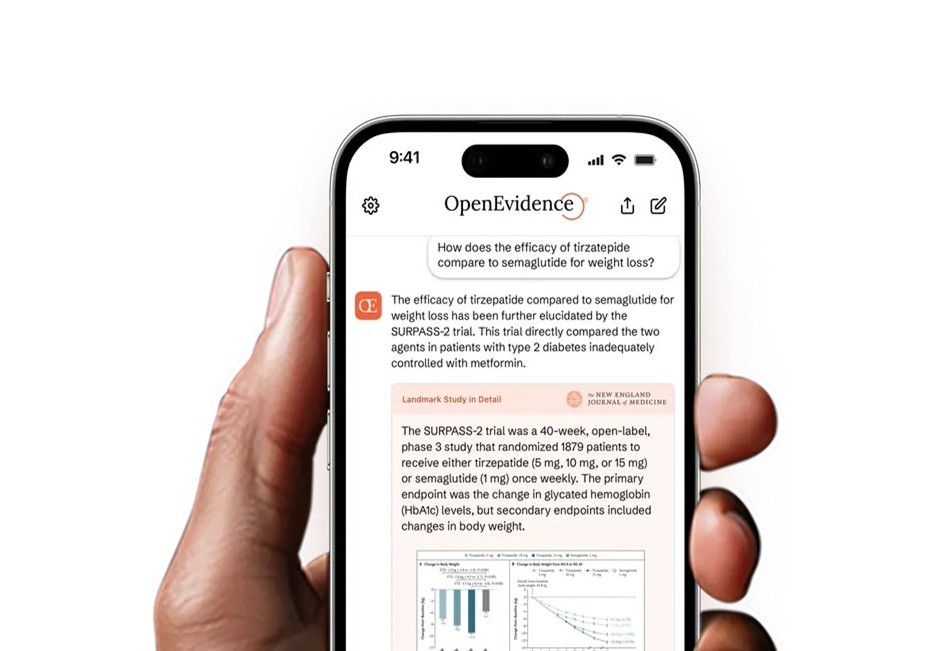
On a busy hospital floor, between rounds and urgent consultations, a physician pulls out a phone and types a question that could shape a patient’s care. The answer comes back in seconds, backed by citations from top medical journals. No guessing. No scrolling through endless PDFs.
For a growing share of doctors in the United States, that moment now runs through one product: OpenEvidence.
That shift in how doctors access medical knowledge just powered one of the largest healthcare AI rounds to date. OpenEvidence, now a Miami-based company, announced a $250 million Series D, valuing the company at $12 billion.
The scale of its adoption explains why investors are paying attention. More than 40% of U.S. physicians now use OpenEvidence daily across over 10,000 hospitals and medical centers. In December alone, verified doctors ran about 18 million clinical consultations through the platform, up from roughly 3 million per month a year earlier. Last year, more than 100 million Americans were treated by a doctor using OpenEvidence, the company said.
At the heart of its rise is a simple problem: modern medicine moves faster than any human can track.
“If a doctor tried to stay current by reading only the new evidence in the top 10 medical journals and only the most recent changes to their specialty guidelines, it would take nine hours of their day, each day,” Daniel Nadler, founder and CEO of OpenEvidence, shared in a statement.
“Without a technology like OpenEvidence, doctors may miss critical new findings or guidelines simply because they lack the time to find them,” Nadler continued. “Doctors want to provide the best care to patients. OpenEvidence is the tool that safely allows them to do that. Our mission is to help doctors save lives and improve patient care.”

Unlike general AI tools trained on the open web, OpenEvidence took a narrower path. It trained its models only on medical journals and medical data. Early on, it also signed formal partnerships with content owners including the New England Journal of Medicine, the American Medical Association, the National Comprehensive Cancer Network, and the American College of Cardiology. That gave it direct access to peer-reviewed literature and helped it earn trust from doctors who are trained to rely on those sources.
Behind the scenes, the product has also grown more complex. According to the company, this fresh funding will go toward research, development, and compute costs tied to a multi-AI architecture made up of medically specialized models, each focused on a different clinical sub-specialty. A central system routes each physician’s question to the most relevant model before assembling a final answer.
Investors see OpenEvidence as more than another productivity tool.
“OpenEvidence is effectively the default operating system of medical knowledge in the United States today,” commented Kareem Zaki, partner at Thrive Capital. “We are thrilled to partner with them.” Thrive Capital was founded by Joshua Kushner, who is also co-founder of tech-forward insurance firm Oscar Health.
Thrive Capital and DST Global co-led the round, bringing OpenEvidence’s total funding to roughly $700 million over the past 12 months, including a $200 million fundraise announced in October. Previous investors include Sequoia, Google Ventures, Nvidia, Kleiner Perkins, Blackstone, ICONIQ, Coatue, and Mayo Clinic, many of which followed on in this round.
OpenEvidence is free for doctors and supported by advertising, a structure that helped it scale fast. The company became one of the fastest of any kind to reach $100 million in annual revenue, doing so in under a year after building out its commercial team.
The company quietly relocated its HQ from Cambridge, MA, to Miami last summer, and Nadler, who previously co-founded and sold AI fintech Kensho in 2018 for about $700 million, purchased a beachfront penthouse in the area too. In an interview today with CNBC, Nadler said this time around, “we’re really fully committed and focused on controlling our own destiny and building this into a very very large company.”
Nancy Dahlberg contributed to this report.
READ MORE IN REFRESH MIAMI:
- OpenEvidence, the ChatGPT for clinicians, has raised $200M on a $6B valuation – and recently moved to Miami
- How Papa is turning companion care into a healthcare must-have
- Biobeat raises a $50M Series B for its US expansion
- Insightec spins out Lotus Neuro to advance brain therapies that tackle ‘a huge unmet need’
- This South Florida skincare tech solution aims to redefine the med spa playbook
- What happens when a digital twin grows up? FIT:MATCH’s leap into sports and health

- Vylit is giving creators a new way to find their fans - October 21, 2026
- Q Intelligence is taking a swing at Hollywood’s money problem - October 21, 2026
- Sunlight AI raises $17.4M to bring back the independent doctor - October 20, 2026