



By Karen-Janine Cohen
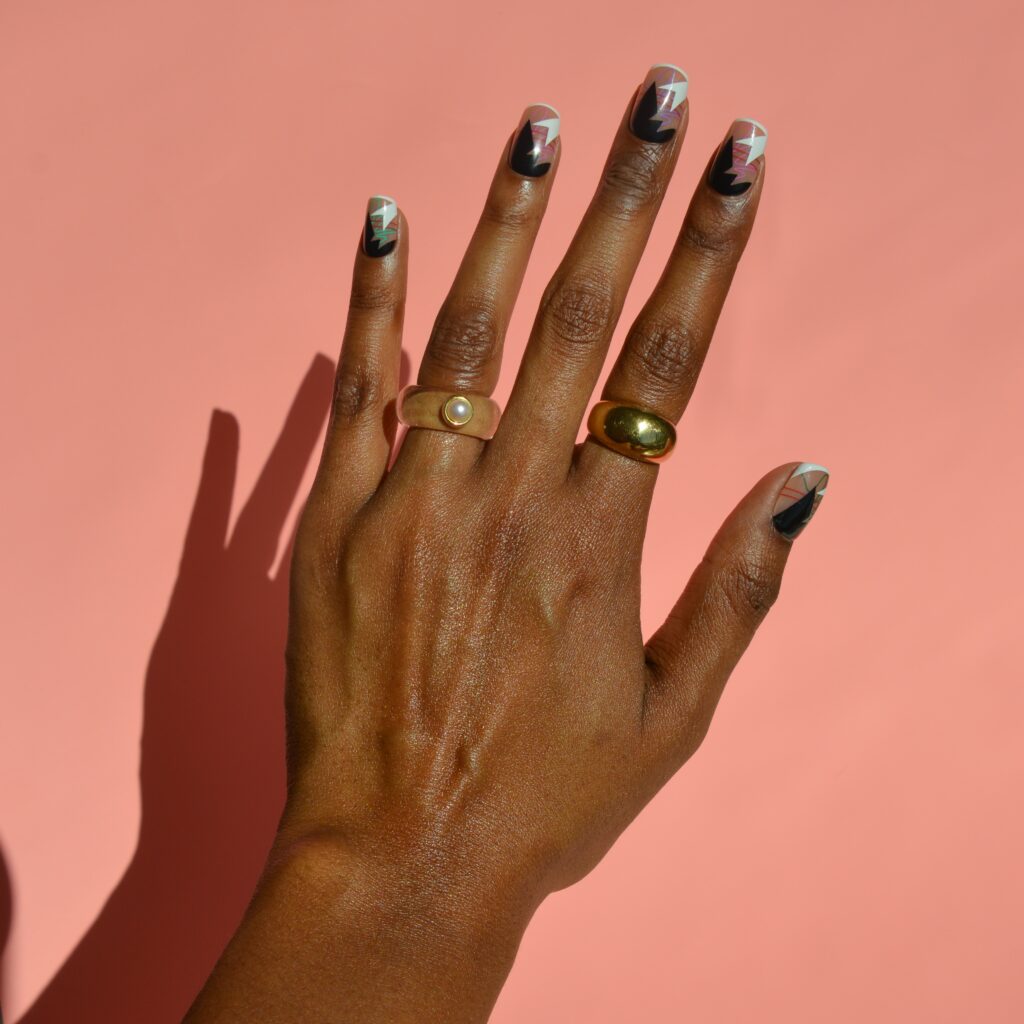
Every entrepreneur has something to teach others. But Aurelia Edwards is not just bringing disruption to the nail beauty industry, she’s willing to share how, long before she conceived of her current firm, she planned ahead for when the right idea would emerge. That idea is Nailstry. Based in the Alan B. Levan | NSU Broward Center of Innovation, Nailstry uses AI to minutely measure clients’ hands and nails, using the info to have individually tailored press-on nails manufactured for a client’s unique fingernails.
Everyone who has been to a wedding, concert or celebration in the last decade has been in the presence of press-on nails – perhaps even wearing them. Long, short, tapered, talon-like or rounded; plain or deeply decorative, the press-on nails market is growing like dandelions. Covid-era nail salon shutdowns fueled the trend, which continues with the convenience, low cost and increasing quality of press-on nails. The market, according to Grand View Research, is expected to reach $1.8 billion worldwide by 2030. In 2023, the market was estimated at $696.6 million, according to the market research group.
But those impressive statistics are not what drew Edwards to the nail industry. As she explained in a presentation at a Sunshine Startups Live.com podcast, it came from the frustration of being short one press-on nail as she was dressing for a celebratory event. Despite having hundreds of nails, she could not find one that fit a certain finger. She was late to the event, but did get the germ of an idea: custom-made press on nails, mapped for each person – the AI came a bit later.
In 2018, six weeks after conceiving the idea, Edwards opened a pop-up store in Manhattan’s West Village – during Fashion Week. “It was a very exciting time, people had never seen that type of demand-option,” she said.
The use of artificial intelligence became a perfect fit. “We couldn’t find anything on the market to take the measurements,” said Edwards. “We were trying to find an out-of-the-box solution that didn’t exist.”

In 2022, she incorporated her company as Standard Measure Technologies, the name reflecting that the platform is more expansive than Nailstry alone. Meanwhile, as AI became more available, software engineers built the Nailstry platform, which functions like a marketplace, connecting nail makers and designers with customers.
Growing up Edwards didn’t envision becoming a technology founder and CEO. Nor was it what her parents expected. “Being from immigrant parents, that would be a doctor or a lawyer,” she said. Her folks, who immigrated from Trinidad and Tobago, moved to South Florida from New York City when Edwards was 6 weeks old. She earned dual undergraduate degrees in biology and chemistry from Florida International University, planning the physician route. But shadowing a doctor showed her that today’s medical practice didn’t provide the satisfaction she expected. So instead, she earned a master’s degree in cosmetic science at Fairleigh Dickinson University in New Jersey.
Meanwhile, to support herself, she pursued another interest, enrolling in massage school. She went on to build a business that, across 15 years, rose to 400 clients. “I would work seven days a week,” she said. “There is a passion and a gift I have for massage,” she said. Running the massage business taught her invaluable basics that smoothed Nailstry’s launch. For one, masseuses must have short nails, so Edwards became familiar with the pros and cons of commercially available press-on nails when preparing for evenings out and special occasions. Other lessons were more practical.
“When I talk about bootstrapping, I tell people: diversify your investments,” she said. Along with insurance policies, Edwards had real estate and other financial instruments she could borrow against or take from when needing cash. And, she became strategic and disciplined about spending – only laying out cash if there was a return.
For example, when pricing a one-hour massage, the cost included tolls, parking, supplies, and so forth. “I understood the necessity of building my pricing around COGS (cost of goods sold) and the expenses around servicing the client,” she said. “I apply this same principle as we think through how to competitively price our technology and what milestones we are targeting to accelerate our growth.”
Nailstry doesn’t manufacture the nails. The platform connects customers to those who design and craft them. Once the idea jelled, and AI came into more common usage, it was a perfect tool to use AI to create the micro-detailed measurement component. Clients take photos of their hands, which are instantly uploaded. Once they choose from a wide variety of designs – which range from ‘off the shelf’ nails to nail artists’ custom-made limited editions – the measurements are sent to the maker. Average prices range from $15 to $150 for about three sets of nails. Depending on the order, clients can get their nails in a matter of days.
To get the word out and create brand awareness, Edwards says they worked with the community, joining Facebook chat groups and talking with independent designers.
So far, Nailstry has served more than 300 customers. It recently also inked a deal with SheaMoisture, a division of Unilever, that plans to make it available through Target. Another deal has been negotiated with Japanese company LProof for nail stickers – which are a bit different than press-on nails – they look more like freshly applied nail polish, and are usually ‘cured’ under a UV light, yet are also applied at home.
Nailstry, Edwards said, is bringing technology into an industry that hasn’t been innovated in decades. Edwards moved into the Levan Center and went through its Accelerate program. “It was amazing, it fosters a great community,” she said. The Levan Center is a public-private partnership between Nova Southeastern University and Broward County that supports South Florida innovation, particularly in the technology field.
Edwards has participated in eMerge Americas, and was a runner-up in the 2022 Miami Herald Startup Pitch Competition FIU Track. All told, she has raised $350,000, including funds from grants and pitch competitions, plus a $100,000 equity investment from accelerator Gener8tor.
Aware of the difficulty entrepreneurs, particularly women and people of color have in securing the first get-off-the-ground funding, Edwards next wants to create an investing fund. “Fundraising is challenging and I’d like to see more support for early-stage companies,” she said. “Getting that money into the hands of companies when getting from 0 to 0.5 is a sweet spot I think we are missing in South Florida.”
READ MORE IN REFRESH MIAMI:
- AI, meet auto parts: A sector just begging for disruption
- South Florida startup Lamatic enables small businesses to capture the power of AI
Reachlink revisited: Boca telehealth company offers a menu of mental health therapies and is branching into AI - Hawkeye MedTech: Fine-tuning the patient-doctor connection
- A fascination with acoustics, engineering and neuroscience leads to ‘hearing’ the heart
- Ditch the salon this holiday season – measure and order your nails virtually with Nailstry

- MyMonthlyCar offers mid-term rentals for most budgets - September 22, 2026
- Petwealth’s at-home tests aim to speed up diagnosis and treatment for our furry friends - May 26, 2026
- Stem cell opportunities expand – and so does GBI - April 8, 2026