



When Tamir Wolf’s wife and former boss both needed an appendectomy, he took them to different hospitals in New York. Same diagnosis. Same city. But two completely different treatment approaches. That experience lit a fuse.
“It became painfully clear that surgical care is highly variable, siloed, and not transparent,” Wolf told Refresh Miami. “Where you live can determine if you live.”
That insight led him to co-found Theator, a company built around one mission: using technology to bring transparency, consistency, and quality to surgery.
Wolf is no stranger to high-pressure environments. He spent years in the Israeli Navy SEALs and served as a physician in the IDF. After transitioning out of clinical work, he dove headfirst into health tech. Then, while building Theator, he was diagnosed with cancer himself. The experience deepened his drive to improve care.
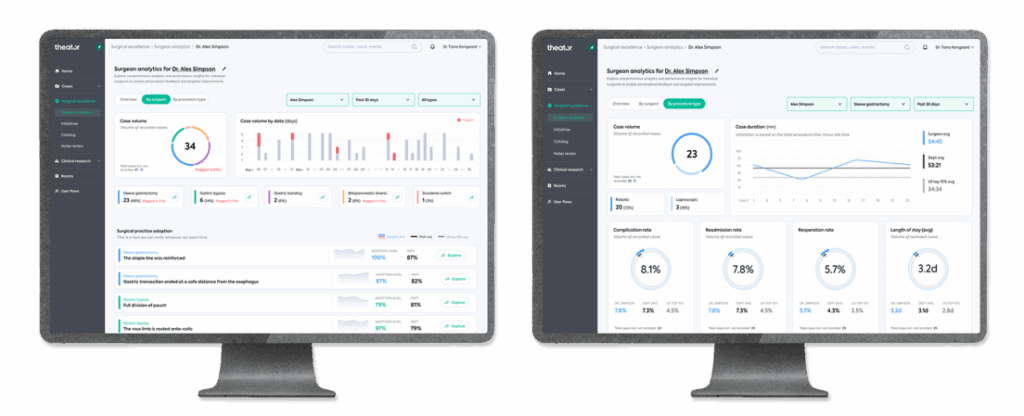
Today, Theator uses AI to analyze surgical video footage from existing hardware in operating rooms, especially in robotic and minimally invasive procedures. Their platform applies computer vision and large vision-language models to break down surgeries into structured data. That helps hospitals improve surgical outcomes, training, efficiency, and safety.
“We call it surgical intelligence,” said Wolf. “It’s a new layer of understanding – what worked, what didn’t – and it helps surface best practices from real-world performance.”
Hospitals are Theator’s direct customers, and their product is enterprise software sold via B2B SaaS contracts. It’s not always an easy sell. As Wolf put it, “Hospitals are judicious, and they should be. We’re dealing with people’s lives. But we’re seeing real momentum now.”
Part of that momentum is local. Since moving to South Florida a year and a half ago, Wolf has developed close ties with the University of Miami and other major institutions. He said the difference between trying to break into systems in California versus Miami is stark.
“In California, it could take years just to get a meeting. Here, within a few months, we had active collaboration. People get it. It’s a collaborative, forward-thinking environment,” he said.
One of Theator’s major breakthroughs came through its work with the University of Miami and Mayo Clinic, where they tested an algorithm to automatically generate operative reports: the documents surgeons traditionally write manually. The results? The algorithm outperformed humans.
“Operative reports are often templated and inaccurate,” Wolf said. “But if we can automate them using video data, not just audio, the impact could be massive both clinically and financially.”
Wolf believes Miami has all the ingredients to become a national healthcare innovation hub. “We have forward-thinking systems, capital flowing in, and now we just need some big success stories. That’s how we’ll attract more founders and build this ecosystem.”
So far, Theator is doing its part. The company is reporting zero customer churn, a Net Promoter Score of 80, and growing traction among leading hospitals. With a 42-person team split between the US and Israel, they’re expanding their presence and partnerships in South Florida.
And as for how Wolf ended up in Miami? “Honestly, my wife. We had friends who moved to South Miami, she visited Coconut Grove, and we realized it had everything Palo Alto did, except with life after 6 p.m.”
READ MORE IN REFRESH MIAMI:
- Boca-based healthtech Dazos raises $25M Series A
- With $10M in tow, Kiwi takes on Latin America’s $60 billion healthcare gap
- Happy V: The Miami-based startup spearheading solutions for vaginal health
- Healthtech startup Definition Health sets sights on Miami to streamline surgery care with AI
- Blumberg Capital is bullish on #MiamiTech: Q&A with founder David Blumberg

- Terminal acquires Miami AI startup Stationed, plans to double team in Wynwood - October 22, 2026
- Vylit is giving creators a new way to find their fans - October 21, 2026
- Q Intelligence is taking a swing at Hollywood’s money problem - October 21, 2026