


By Nancy Dahlberg
Elon Musk may have Washington on his mind, but his brain chips are headed to Miami.
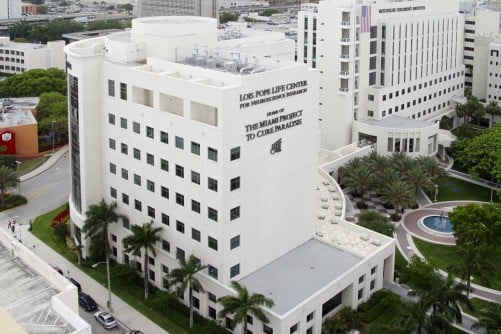
Neuralink, Musk’s startup, has selected the University of Miami’s Miller School of Medicine to be the second US clinical trial site to test whether its brain chip – a brain-computer interface implant – can give people who are paralyzed the ability to use only their thoughts to control their smartphones, computers and other electronic devices.
“The Miami Project to Cure Paralysis and the University of Miami are renowned for their pioneering research in neural interfaces for the treatment of debilitating neurological conditions such as spinal cord injury and ALS. We look forward to partnering with them as a site for our PRIME Study,” DJ Seo, co-founder, president and COO at Neuralink, said in a statement.
The Neuralink PRIME (Precise Robotically Implanted Brain-Computer Interface) Study will seek to assess the safety and functionality of Neuralink’s N1 Implant. This brain-computer interface (BCI) implant establishes a wireless, digital link between the brain and computers. The study will also evaluate Neuralink’s R1 Robot, a surgical robot that precisely and rapidly places the N1 Implant’s ultra-fine electrode threads within microns of targeted neurons.
“This study will use the latest technological advances in BCI approaches for improving function and quality of life in individuals living with the consequences of chronic spinal cord injury, as well as amyotrophic lateral sclerosis (ALS),” said Dr. Allan Levi, a UM professor and chair of neurological surgery and a co-investigator, in the announcement.
The implant procedure will be carried out by Neuralink scientists and a multidisciplinary team of neurosurgeons, neuroscientists and biomedical engineers at The Miami Project to Cure Paralysis and the Miller School of Medicine.
The procedure is less invasive than other types of brain surgeries because the Neuralink procedure occurs on the superficial surface area of the brain and requires a relatively small incision, he told the Miami Herald. “I really think it’s going to be a game changer.”
Neuralink was founded in 2016. The U.S. Food and Drug Administration gave the green light in May 2023 for Neuralink to begin human clinical trials for its Telepathy brain chip. A year ago, Musk announced the first human patient was implanted with the brain chip at the Barrow Neurological Institute in Phoenix. That patient was able to control a computer mouse using the mind.
Two other people have received the implant, according to the Miami Herald report. One of them, who had a spinal cord injury, has been able to play video games and use computer-aided design software to design 3D objects.
Neuralink is reportedly also working on “Blindsight,” an implant to restore vision.
For the PRIME Study, Neuralink is specifically looking for adult patients who have limited or no ability to use both hands due to cervical spinal cord injury or ALS. Individuals interested in learning whether they may qualify for this trial can join Neuralink’s United States Patient Registry.
“This collaboration represents another great opportunity to combine our clinical research expertise with the forward-thinking team at Neuralink. We hope this partnership is another significant step in finding meaningful solutions for the millions living with paralysis and other significant motor deficits,” said Marc Buoniconti, president of The Miami Project.
Buoniconti is the son of the late Miami Dolphins linebacker Nick Buoniconti. He became a quadriplegic following a spinal cord injury playing college football. With the involvement and support of the Buoniconti family, The Miami Project, a Center of Excellence at the University of Miami, was formed in 1985 to focus on developing new strategies for repairing the nervous system following spinal cord and brain injury, and to improve function and quality of life.
READ MORE IN REFRESH MIAMI:
- Meet the startups shaping the future of healthcare, from Miami to the world
- University of Miami launches new startup accelerator for student entrepreneurs with $5M donation
- University of Miami research lab makes strides with AI and mobility
- Cheers to #MiamiTech 2024: A global ranking, healthtech and proptech rising, megarounds, new funds, a climatetech hub & more

- From Miami to the World: How a Miami 16-year-old is scaling access to tech education - October 15, 2026
- MDIA lands $3M Knight Foundation investment to expand its innovation model nationwide - October 14, 2026
- Ambition Accelerated kicks off statewide accelerator in key sectors. Here are the 19 South Florida startups selected - October 13, 2026