



In January, we reported that Elon Musk’s startup Neuralink had selected the University of Miami’s Miller School of Medicine to be the second US clinical trial site to test whether its brain chip – a brain-computer interface implant – can give people who are paralyzed the ability to use only their thoughts to control their smartphones, computers and other electronic devices.
The Neuralink PRIME (Precise Robotically Implanted Brain-Computer Interface) Study seeks to assess the safety and functionality of Neuralink’s N1 Implant. Neuralink’s implant is placed beneath the skull and uses 64 tiny wires equipped with electrodes that can read neuron activity in the brain. The study will also evaluate Neuralink’s R1 Robot, a surgical robot that precisely and rapidly places the N1 Implant’s ultra-fine electrode threads within microns of targeted neurons.
Now the University of Miami has reported that its first patient known as RJ, a U.S. military veteran who was paralyzed after a motorcycle accident, received his implant by surgeons at The Miami Project to Cure Paralysis and the Department of Neurological Surgery at the University of Miami Miller School of Medicine.
With his Neuralink implant, RJ is able to control his computer and smart phone with his thoughts.
RJ received his implant at UHealth Tower, the flagship University of Miami Health Systam hospital, in April 2025 and was discharged from the hospital the day after his surgery, UM reports. Four other patients have received the implant at other study sites.
“I’m so proud of our Miami Project and University of Miami team who worked tirelessly with our Neuralink colleagues to help shape history – ultimately benefiting our first patient immensely. Undoubtedly this will have an enormous impact on future patients,” said Dr. Allan Levi, a UM professor and chair of neurological surgery and one of the study’s co-investigators, in UM’s report.
Calling Neuralink “a game changer,” RJ told the University of Miami that he was thrilled with the surgery and his life with the implant in place.
“They’re giving me my spark back…my drive back. They’ve given me my purpose back,” RJ said.
Neuralink, founded in 2016 by Musk and a team of engineers and scientists, created technology that has already changed the lives of seven participants. The next milestone is to go to market and over several years scale this technology to thousands of people as well as expand functionalities of the Neuralink, the company said.
A few weeks ago, Neuralink announced it had raised a $650 million Series E venture capital round at a reported $9 billion valuation. In total, Neuralink has secured about $1.3 billion in venture capital.
A recent video update by Neuralink contains highlights of how PRIME study participants including RJ have used their implants in daily life. During hourlong update, Musk said the company is working closely with regulators and “the reason we’re not moving faster than we are is because we’re taking great care with each individual to make sure we never miss and, so far, we haven’t … Every one of our Neuralinks that have been implanted are working really well.”
Musk added later in his remarks: “There’s a lot of really smart people working on a lot of important problems. This is one of the most difficult things to actually succeed in creating — and have it work and work at scale and be reliable and available for millions of people at an affordable price. Come join and help us solve this.”
For the PRIME Study (NCT06429735), Neuralink is seeking patients who have limited or no ability to use both hands due to cervical spinal cord injury or ALS. Individuals interested in learning whether they qualify for this trial can join Neuralink’s United States Patient Registry.
“We are excited to move forward applying this new technology and combine our clinical research expertise with the forward-thinking team at Neuralink. We know this collaboration will be another great step forward and hopefully lead to meaningful results for the millions living with paralysis and other significant motor deficits,” said Marc Buoniconti, president of The Miami Project to Cure Paralysis, in a statement.
The Miami Project, a nonprofit renowned for its pioneering research, is entering its 40th year.
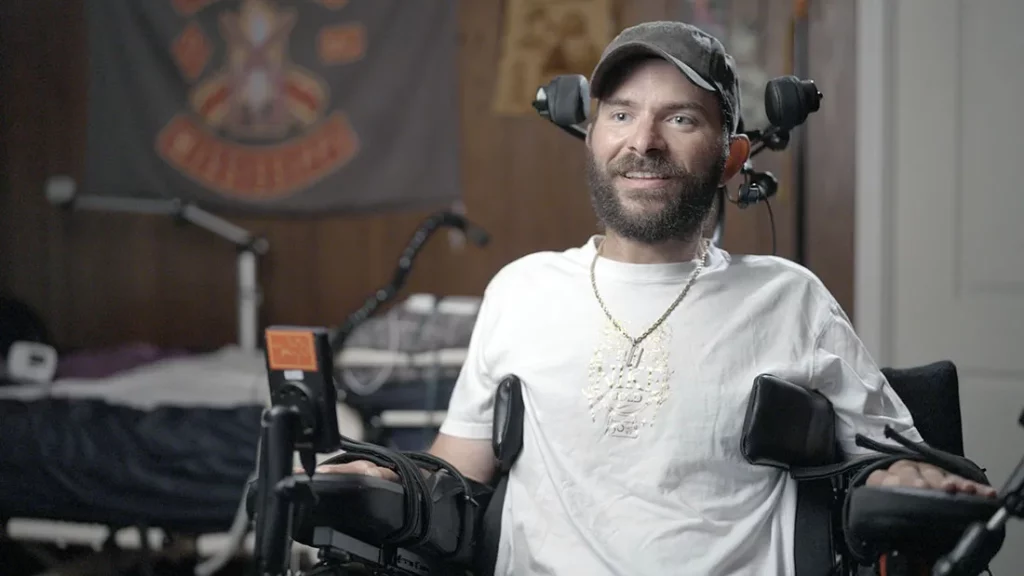
Pictured here: RJ, the first patient at UM to receive the Neuralink implant. Pictured at the top of this post: The UHealth and The Miami Project to Cure Paralysis team with Elon Musk (center) at UHealth Tower. Photos are from the University of Miami.
READ MORE IN REFRESH MIAMI:
- UM to be prime testing site for Neuralink, Elon Musk’s brain chip startup
- How a University of Miami startup is using nanotechnology to transform agriculture
- Meet the startups shaping the future of healthcare, from Miami to the world
- University of Miami launches new startup accelerator for student entrepreneurs with $5M donation
- University of Miami research lab makes strides with AI and mobility

- From Miami to the World: How a Miami 16-year-old is scaling access to tech education - October 15, 2026
- MDIA lands $3M Knight Foundation investment to expand its innovation model nationwide - October 14, 2026
- Ambition Accelerated kicks off statewide accelerator in key sectors. Here are the 19 South Florida startups selected - October 13, 2026