

By Robert C. Jones Jr. – University of Miami News
Just north of Cuba, Tropical Storm Debby was beginning to intensify into a hurricane. For crew members aboard Miss Piggy, one of the National Oceanic and Atmospheric Administration (NOAA)’s three hurricane hunter aircraft, the ride would get a lot bumpier.
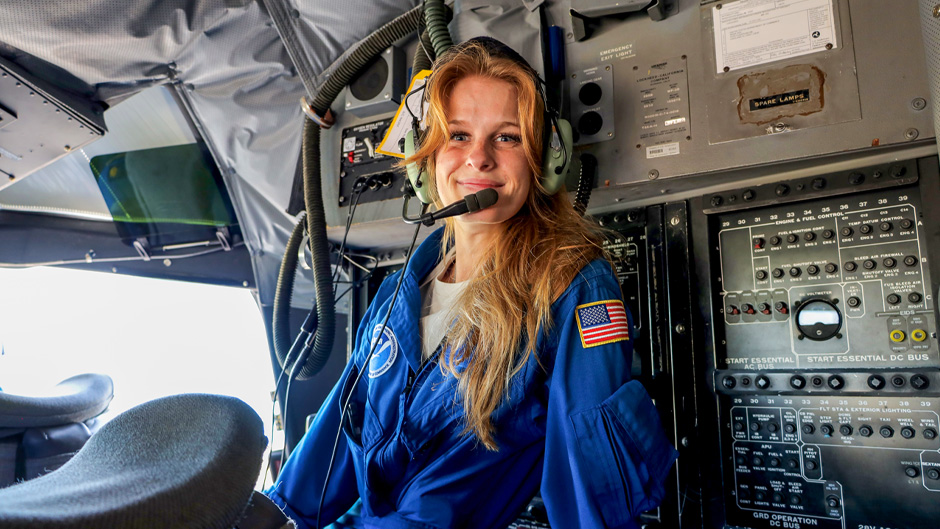
On board that early August flight was Devon Ledbetter, a Master of Professional Science student at the University of Miami Rosenstiel School of Marine, Atmospheric, and Earth Science.
She didn’t take the flight to help gather data that would allow forecasters to predict a storm’s path, but to capture 360-degree video footage of an eight-hour hurricane hunter mission.
Ledbetter will use the content to create a virtual reality experience, allowing science buffs and anyone curious about hurricane research to don a headset and take a flight aboard one of NOAA’s famous hurricane hunter aircraft as it flies into the heart of a cyclone.
“It’s not feasible for everyone to take a flight aboard a hurricane hunter,” she said. “But by leveraging emerging technologies like virtual reality, we can connect the public to science. This VR project will teach them about the research being conducted by tropical cyclone experts. It’ll raise awareness about hurricanes and teach the public that it’s important to track storms to protect communities.”
From the crew members preflight briefing to the four-engine turboprop’s takeoff from a Lakeland, Florida, airfield, to a look inside the cockpit and the cabin where scientists use sophisticated radar and deploy dropsondes to collect temperature, humidity, and pressure readings, “this will be a total immersive experience,” Ledbetter said.
A pilot herself who is licensed to fly multi-engine aircraft, she has flown on two hurricane hunter missions so far, and with atmospheric and oceanic conditions continuing to set the stage for an extremely active Atlantic hurricane season, she may have the opportunity to fly on other missions to collect more footage for her VR project.
Ledbetter, who is on track to earn her degree this December, is creating the VR experience as part of her internship with NOAA’s Atlantic Oceanographic and Meteorological Laboratory (AOML), a Key Biscayne-based facility conducting research that spans tropical cyclones and hurricanes, coastal ecosystems, oceans and human health, and climate studies.
“Devon’s innovative use of virtual reality to bring our audience into the field with us sets a new standard for how we communicate complex scientific concepts,” said Laura Chaibongsai, communications lead at AOML. “Her creativity, technical skills, and determination are truly transforming the way we engage with the public.”
The project, said Ledbetter, will be completed by the time she graduates. Then, other AOML communications team members will take the baton, expanding the headset’s capabilities to allow users to pick up a weather reconnaissance device and deploy it from an aircraft. “Just imagine how cool that will be,” Ledbetter said.
AOML plans to use the VR headset at its public outreach events, according to Ledbetter.
In addition to the VR project, she is supporting AOML’s communications team throughout this year, developing public outreach and social media strategies for the Hurricane Research Division.
“Science communication has always been one of my passions,” said Ledbetter, who earned her undergraduate degree in marine affairs and communications from the University. “It’s all about education and awareness. With all that is happening with our planet, the more the public is informed, the better.”
This story was originally published by University of Miami and is being reposted here with permission.
READ MORE IN REFRESH MIAMI:
- University of Miami launches new startup accelerator for student entrepreneurs with $5M donation
- University of Miami research lab makes strides with AI and mobility
- This UM professor is building a next gen eVTOL, and NASA wants to bring it to Mars
- $5M gift to UM to help elevate student entrepreneurs with new accelerator program and funding

- America’s next 250 years need Miami - October 19, 2026
- Will Claude’s new AI ‘watermark’ keep us all honest? - October 9, 2026
- Ken Griffin’s message to UM students: Work with AI, don’t fear it - October 9, 2026