


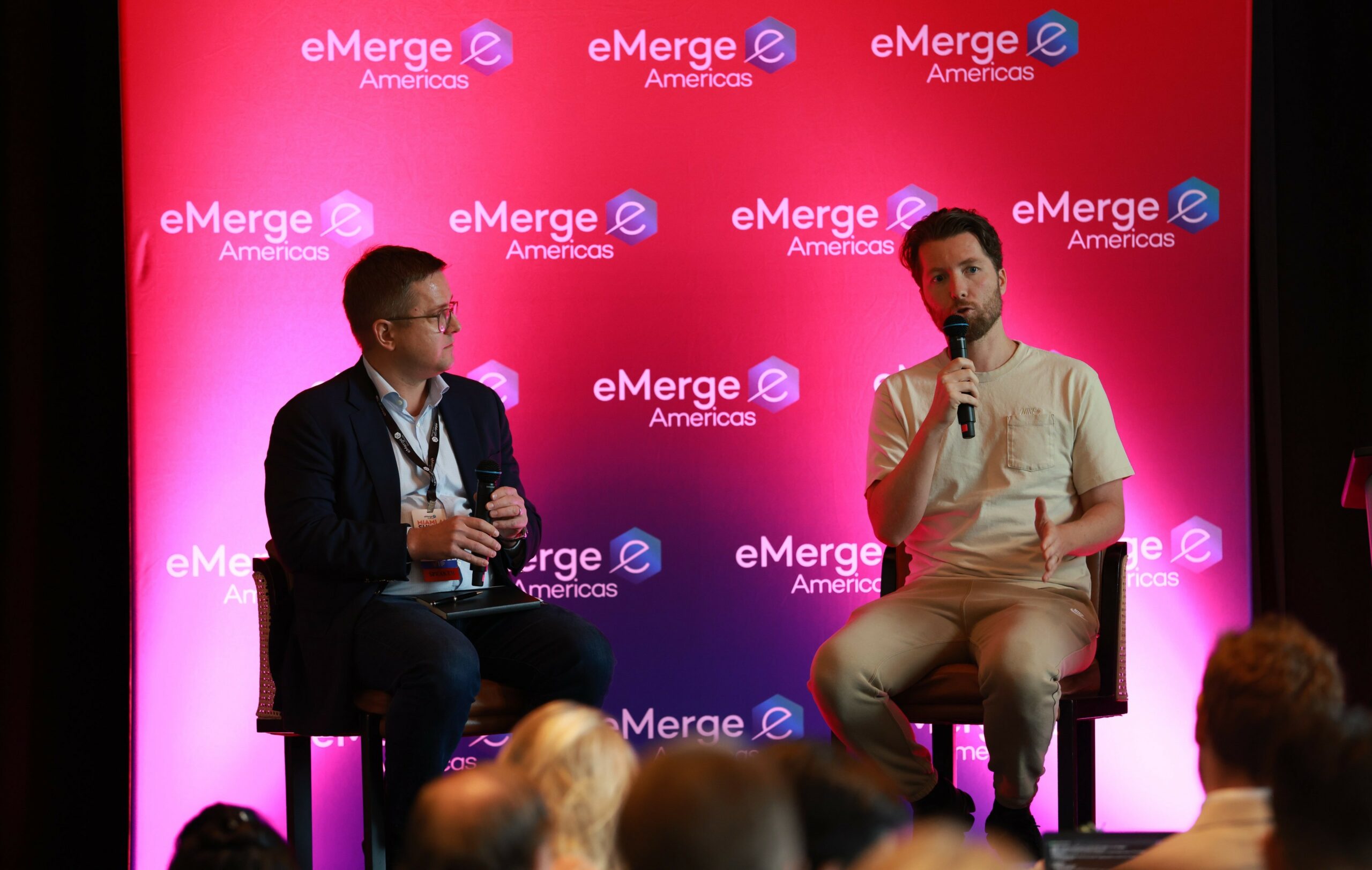
The daylong summit drew a full-house: 800 founders, investors, enterprise executives, and national security leaders. Here are some highlights.
Within the next 24 months, the majority of companies won’t just consume artificial intelligence. They will become AI builders, customizing, controlling, and running their own models.
Hugging Face co-founder and CEO Clément Delangue made that prediction during his keynote at the Miami AI Summit on Oct. 23. Speaking to a packed hall following Hugging Face’s landmark $12.9 billion deal to join Nvidia last month, Delangue urged enterprise leaders to resist the temptation of relying solely on closed-source APIs like those provided by OpenAI and Anthropic, calling this a “scary path” that allows a few companies to hold too much power.
“When you are thinking about building versus buying, fight the urge to just rent from OpenAI or Anthropic,” Delangue challenged the audience. “Instead, create the conditions for your teams to feel comfortable building AI themselves with open source.”
Delangue warned that centralizing AI capabilities within a few closed-source frontier labs poses a serious threat to economic stability and national governance. “When you think about the economy, what happens if most of the benefits of AI are concentrated in two or three frontier labs?”
“Working to have a much more decentralized, distributed AI sector is really, in my opinion, one of the most important topics that we can work on right now,” he said.
An electric scene in Coral Gables
Delangue’s vision set the tone for a high-energy day at the Lowes Coral Gables Hotel’s conference center. Produced by eMerge Americas and led by Chief AI Officer Burhan Sebin, the summit drew 800 founders, investors, enterprise executives, and national security leaders, with attendees flying in from California, New York, Colorado, and Canada. Even as keynote conversations unfolded on the main stage, hundreds of participants filled the surrounding halls in a loud, busy atmosphere of networking and dealmaking.
For eMerge Americas CEO Melissa Medina, the summit’s national draw signals that South Florida has long passed the point of mere potential. “The intellectual capital that we have at this event today is proof that the region is a tech hub, with all the ingredients to keep growing and attracting more people and more funding,” Medina told Refresh Miami. “All these people are here in Miami because they want to be a part of this ecosystem. It’s not just hype.”
In an interview on CEOs You Should Know on iHeart Radio before the event, Medina reflected on the city’s trajectory, emphasizing how public-private collaboration across five key pillars — entrepreneurs, investors, corporate leaders, academia, and government — has built the foundation that allowed the post-2020 migration of capital and talent to ignite a “J-curve” growth era for Miami.
Open source as the ultimate defender
During his fireside chat with Derick Duchodni, managing director at J.P. Morgan, Delangue pushed back against claims that open source increases cyber risks. He revealed that when Hugging Face was targeted by an autonomous AI agent cyberattack earlier this year, proprietary API guardrails blocked defenders alongside attackers. To neutralize the threat, Hugging Face relied on open models, specifically a model called GLM 5.3 developed in China and running on Nvidia infrastructure, to protect its systems.
“Most defense will be provided by open source,” Delangue said, emphasizing that arming defensive applications with open-source models creates a far more resilient society than trusting secretive frontier labs.
Another anticipated appearance at the summit was Kamyar Azizzadenesheli from Prometheus. Co-founded by Jeff Bezos and Vik Bajaj, the startup is developing AI tools to speed up engineering and the process of turning ideas into physical products. Bezos called its long-term goal an “artificial general engineer.”
Enterprise token economics and the Pentagon’s playbook
The shift toward open architecture echoed across the summit’s enterprise panels. On a panel about the rise of agentic systems and how companies are redesigning workflows around them, Augusto Marietti, CEO of API infrastructure leader Kong, said that enterprise token consumption on open-weight models grew from near zero six months ago to 30% of total traffic today, as CFOs demand strict token budget management. Will Koffel, Director of Nvidia’s Inception startup program, added that autonomous agents are fundamentally reshaping startup formation, noting Nvidia recently updated its startup program eligibility to include solo founders managing “an army of agents” to run $100 million-plus enterprises.
“We need to appreciate the diversity of startup opportunities. We commoditized the intelligence part; the human part is now judgment and taste,” Koffel said.
In a national security panel, defense leaders showed how autonomous workflows are scaling inside the military. Representatives from the Pentagon’s Chief Digital and AI Office (CDAO) highlighted GenAI.mil, an initiative that has onboarded LLMs for nearly 2 million Department of Defense users across 500,000 custom agents. Matt Suma, a former CIA officer representing Cognition AI, which created the autonomous software engineer Devin, summarized the cultural transformation: “The military should get out of the mentality of strictly being buyers and get back into the mentality of being builders”
Next-gen founders and a 30-year vision
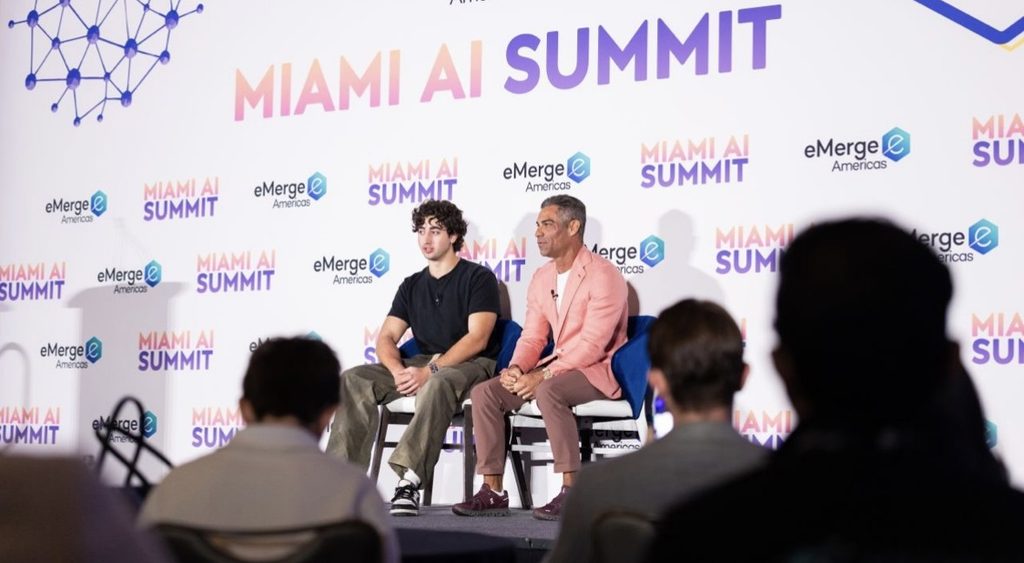
The summit closed with a lively fireside chat between former Miami Mayor Francis Suarez and 19-year-old founder Zach Yadegari. The audience erupted in laughter as Suarez poked fun at the generational contrast, highlighting how Yadegari. a self-taught developer who built viral web projects at 13, scaled his calorie-tracking app Cal AI to 15 million users and $30 million in revenue before moving to Miami and launching his new AI assistant startup, Persona.
Asked to look 30 years into the future when he reaches age 49, Yadegari envisioned running a massive frontier tech enterprise pushing the boundaries of AI and brain-computer interfaces. “Ideally, I would be running a very large-scale company with thousands of people working on the frontier of technology,” he said.
Throughout the day, smaller workshops offered practical guidance and feedback from people working in the field. “AI Teammates That Get Work Done with SpaceX” shared tips on how to build with Grok, while “Build What Doesn’t Exist” had Base44 teaching techniques to turn ideas into working solutions.
As the summit wrapped up, attendees headed to the hotel’s rooftop terrace overlooking Coral Gables for a sunset happy hour. Over pans of traditional Spanish paella and tapas, accompanied by the rhythms of a live bossa nova trio, founders and investors celebrated a day that solidified Miami’s position at the center of the open-source AI revolution.
READ MORE IN REFRESH MIAMI:
- It’s a deal, #MiamiTech! Carnegie Mellon to open a Wynwood campus
- Up, up, up: South Florida on way to another strong VC year, PitchBook’s Q3 report shows
- Ambition Accelerated kicks off statewide accelerator in key sectors. Here are the 19 South Florida startups selected
- Palantir plants its HQ flag in Miami
- a16z plants American Dynamism base in West Palm Beach
- From Miami to the World: How a Miami 16-year-old is scaling access to tech education

- At Miami AI Summit, Hugging Face CEO Clem Delangue predicts every company will become an AI builder - October 24, 2026
- Anna Skaya built a pet genetics company. Now she’s funding pet startups and creating something new, this time in Miami. - October 20, 2026
- Miami AI Summit grows up: New name, bigger crowd, $13B keynote - October 16, 2026