



By Nancy Dahlberg
Jeff Bezos began dreaming of building a space company while attending Palmetto High 40-plus years ago. That kid raised in the Miami area wanted to move heavy polluting industry off Earth – and it’s still his dream. “This is something multiple generations will work on, but it will happen,” Bezos told the crowd at the America Business Forum on Thursday. “We have unlimited energy in space and unlimited material resources in space, and this planet is so beautiful and so unusual, this is the one that we’re going to want to protect.”
The founder of Amazon, one of the world’s most valuable companies, is now building aerospace company Blue Origin. Its New Glenn Rocket, Blue Origin’s heavy-lift launch vehicle designed to deploy satellites that can facilitate cloud computing services in low Earth orbit, will be launched Sunday, only for the second time.
While the company is working on cloud computing in space, Bezos believes data centers in space could be next, a critical need in the age of AI, he said in his stage conversation with Miami Mayor Francis Suarez, who chaired the board of this year’s America Business Forum in Miami. Suarez was also heavily involved in selecting and recruiting the A-list speakers.

“Fundamentally, I’m an inventor… I don’t think there’s any problem if we apply human engine ingenuity to it that we can’t solve. And it’s fun to do that too,” Bezos said.
“I think when you’re talking about invention, you have to be a wanderer. A lot of the most important discoveries and most important inventions don’t come from knowing where you’re going,” he continued.
That eagerness to invent is one of Bezos’s four keys to success at Amazon, and they apply to Blue Origin, too. The others were absolute customer obsession, long-term thinking, and operational excellence.
Bezos was the closing speaker in America Business Forum’s two-day all-star speaker lineup that included leaders in government, business, tech, and sports, including President Donald J. Trump, Jamie Dimon, Lionel Messi, Serena Williams, Nobel Peace Prize winner Maria Corina Machado, Saudi government and business leaders, the CEOs of F1 and FIFA, and others. “This conference is our gift to you. The future is not something we wait for – it is something we are building together,” Suarez told the crowd as the conference opened. The Kaseya Center was full to capacity on Wednesday, and was nearly full on Thursday. The Forum’s content was also livestreamed.
Like many other speakers at the Forum, Bezos praised Mayor Suarez for actively encouraging his recent return to Miami and for being the visionary leader of Miami tech’s ascent. Suarez called Bezos “the ultimate use case for a successful ecosystem.”
Calling Miami “completely transformed,” Bezos has invested in homes for himself and his family here in recent years; Amazon is expanding its Miami footprint, too. “It’s an incredible city today. It has the energy and the dynamism, and I love the Latin part of the culture here. When I land, I can just feel the energy… It’s good to be home.”
Yes, but Bezos did have one suggestion for the Magic City: “Miami should have an AI application that reads your building permit for a new house or a new building, and it should give you a yes or a no in 10 seconds, and if the answer is no, it should tell you the six things you have to change to get a yes. Why does it take months and months and months to get a building permit?” The crowd erupted with cheers.
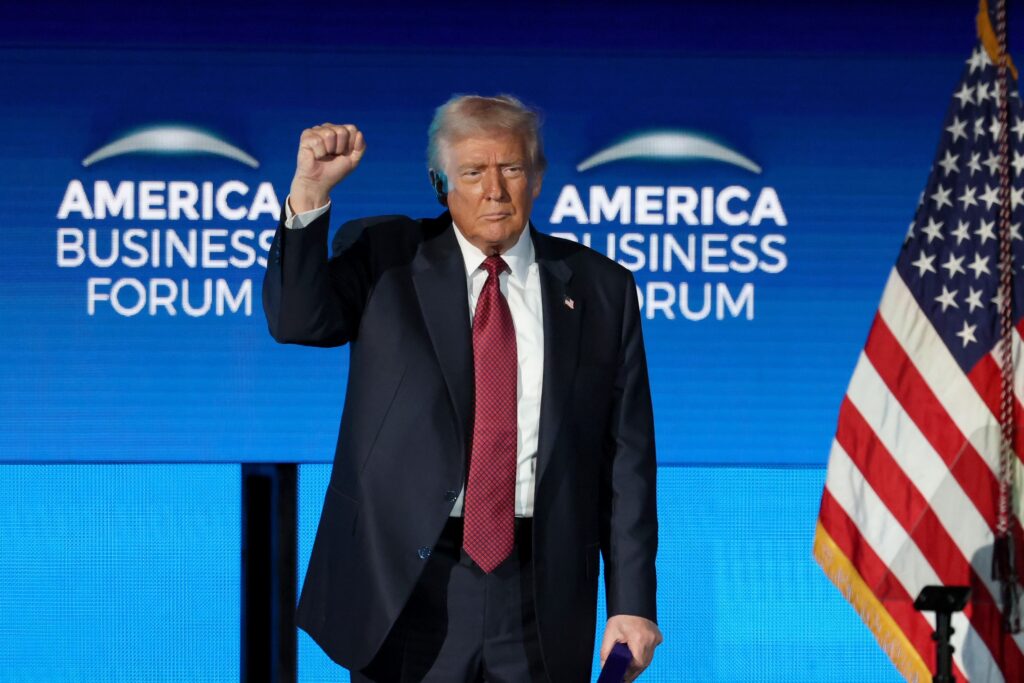
President Trump, whose song for taking the stage was “Proud to be an American,” was not the only leader to speak about New York’s election this week, but he had the biggest audience by far, as the Kaseya Center was packed floor to the top of the bowl for his one-hour speech. Trump told the Miami audience to expect an exodus after Zohran Mamdani’s win in the New York mayoral election this week.
“The Democrats are so extreme that Miami will be the refuge for those fleeing communism in New York City… I live in New York but now I want to leave because I don’t want to live in a communist regime,” Trump said to applause.
While in most of his speech, he trumpeted his administration’s accomplishments in the first year of his second term and what he is working on, Trump had this prediction for Miami’s active crypto sector: “Crypto is no longer under siege. We’re making the US the undisputed crypto capital of the world.”
Many of the speakers spoke of Miami’s opportunity and delivered leadership lessons in this age of historic, transformational change. Let’s hear from a few more of them.

“When I started Citadel 35 years ago, it was the intersection of computers, quantitative analytics and finance, the brave new world of Wall Street. And over the 35 years, by combining knowledge across all three spectrums, we have built one of the world’s most successful investment firms,” said Ken Griffin, founder and CEO of Citadel, a financial powerhouse managing nearly $70 billion.
In an on-stage conversation with Mayor Suarez, Griffin said playing soccer for 35 years of his life taught him the power of the team. “One of the great strengths of Citadel over the last 35 years has been our constant focus on just always recruiting the best and brightest,” he said. “Business is also about hustling. It’s about going the extra mile.”
Also on the subject of recruiting top talent, Griffin warned that Trump’s immigration policies could mean a much smaller labor force, which could be a big problem for tech startups and innovation. “Every [foreign] student should have a green card stapled to their diploma,” Griffin said to applause.
Griffin moved his family and company to Miami from Chicago a couple of years ago. Since then, he has donated million, particularly for education, and is building a new headquarters in Miami for the firm.
“Do you know how great it is to go to dinner and people talk about their children, they talk about their future, and they do so with excitement and enthusiasm? We lost that in Chicago in the last 10 years,” he said. Noting the importance of optimism in entrepreneurship,“it is so great to see the optimism that we have here in Miami.”
Griffin’s advice for business leaders: “When you’re in a competitive environment, you always have to be focused on what would the startup of this moment do to compete with you and to beat you. It’s important to never be complacent and to always think about where the world is heading. What are your shrewdest competitors doing and how do you get there first? The minute you start saying you’re the best is the minute you start to write your own epitaph.”

JPMorgan Chase CEO Jamie Dimon leads the world’s most powerful bank not by following the crowd. He took the stage on Thursday, sharing some of his leadership strategies.
“I read five papers. I read everything people send me. I just constantly read, surveying the landscape of competitors, countries and stuff like that. The second way is just getting on the road, talking to a lot of people — the best ideas come from places you don’t expect,” he said. Those places include bank branch offices, corporate customers, and top companies in other industries – like Google, Dell, WeChat and Alibaba. And he adds it also takes constant curiosity – “once your mind closes, you’re not going to be able to make a lot of progress.”
On AI: “It’s going to affect the way I look at every application, every job, every customer interface, everything we all do. It’s going to be unbelievable. It will cure a lot of diseases that we’ve all been afflicted with… Embrace it. We’ve been using it now for 13 years. It’s literally at the beginning, … the waves of this are coming fast.”
However, he said, it will take the government business working together on retraining, income assistance, and early retirement relocation programs to help people through it.
JPMorgan just recently announced a $1.5 trillion Strategic Resiliency Initiative to finance investment or loans for companies that help make America and its allies resilient , such as aerospace, defense, AI, quantum, energy including data centers, and advanced healthcare initiatives. “We want to do our part. And you know, if you look back, we all should have started doing this 15 years ago,” Dimon said.
On regulation: “We should all get involved in trying to fix these policies that would make our country work far better, and deregulation is part of it. If you don’t believe me, go to Europe, folks. Europe used to have a GDP per person of 90% of America’s, it’s now 65% of America’s. It’s on its way to 50% of America, which will jeopardize the health of Europe itself over time. And it’s all anti-business, anti-investment, anti-innovation, and they kind of know it, and they don’t fix it.”

Entrepreneurial success takes a combination of intelligence, grit and curiosity, said Eric Schmidt, former CEO and chairman of Google chair and CEO of Relativity Space.
“If I was a teenager today, I would be online all the time just learning… I’d train myself to look at businesses and say, how do they work?” But intelligence and grit aren’t enough, he said: “It’s the people who have an idea that’s very clever, and they have the tenacity to push it — those things come from curiosity.”
Lead the team, make a bet, and iterate and iterate and iterate, said Schmidt. “For many of my favorite entrepreneurs, the first idea didn’t work, the second didn’t work, the third didn’t work, and the fourth, boom, right? So never stop trying.”
On AI: “What’s interesting is about 3 1/2, maybe 4 years ago, there was a moment in San Francisco where people realized that these models could write, and boy, could they write. That’s a real discovery moment. It’s one of those historic moments in history, similar to physics and chemistry and things like that,” Schmidt said.
Yet, we still need humans. “The human talent of America is why we are exceptional. Focus on humans, focus on their education and their culture and their development and their curiosity and their energy and their tenacity, and help them with the various travails that happen in life,” Schmidt said.
“AI is going to be the most powerful tool humanity has ever created — it’s also potentially going to be the most dangerous … The most important thing is this stuff needs to be built in America on our values, America’s rule of law, its individual freedom. We’re on a revolutionary frontier here.”

Tennis superstar and startup investor Serena Williams discussed her journey from tennis to entrepreneurship, emphasizing she always had a business mindset and began investing in early stage startups as well as in sports teams more than a decade ago. She highlighted investments of her VC firm, Serena Ventures, which is focused on early-stage tech and particularly on women-founded startups, a market which receives a small sliver of venture capital .
“I really love investing in things that are doing good, but al making a lof of money, quite frankly. And we have lots of companies in portfolio that are doing just that,” Williams said.
Of the 85 investments made, 14 are already unicorns, she said.
There’s no secret sauce behind that success, Williams said. “We really brought in a lot of experience in the firm to be able to take our founders to the next level, because that’s what it’s all about. … We’re investing in companies that are changing how people are living their everyday lives, and changing them for the better.”
Williams also stressed the significance of AI integration: “Everything that we invest in, if they don’t have a future in AI, if they’re not thinking about AI, then we are second-guessing that investment,” she said. Williams is also proud of Serena Ventures’ commitment to women’s health, citing one of her portfolio companies that received FDA approval for at-home pap smears.

Adam Neumann, co-founder and former CEO of WeWork and now the founder and CEO of Flow, talked about developing his new real estate company in South Florida, where he and his family moved to during the pandemic. “Experiential real estate has never been more important, and that’s what we’ve created here in Flow,” Neumann said Wednesday in conversation with Mayor Suarez.
Most recently in August, Flow joined with Canada Global and Yellowstone Trust to buy a majority interest of a massive mixed-use project along the Miami River in the Brickell Financial District. Other Flow projects in this region include a mixed-use project in Aventura (also in partnership with Canada Global), the Flow House Miami condominium project at Miami Worldcenter, and the redevelopment of a trailer park in El Portal.
Looking ahead, Neumann said Flow is expanding in Riyadh, the capital of Saudi Arabia, and considering more growth in that region. One draw: 70% of the population is under 35.
“For us as New Yorkers, Miami wasn’t an obvious thing. When we got to Miami, we were shocked by what we found,” Neumann said about his move during the pandemic. “I’ve done business in 130 cities and 70 countries around the world, and I’ve never been more welcomed and had a better city to work with.”
Will the America Business Forum return in 2026? No announcement has been made (yet), but Ignacio Gonzalez, Founder of America Business Forum, told the Miami Herald he hopes the Forum will have a three-year run in the Magic City. See you next year? Stay tuned.
READ MORE IN REFRESH MIAMI:
- Miami’s tech opportunity is to take on New York City, not San Francisco
- Is the Crypto Capital back? Miami’s next wave of events says so
- Crypto keeps building in Miami, and investors are paying attention
- Miami startups bagged $754M of VC in Q3, PitchBook reports. What were the top deals?
- Miami startup BOB raises $5.5M to build AI-powered finance employee - October 22, 2026
- Carnegie Mellon names dean and VP of Miami campus. Let’s meet him. - October 20, 2026
- 10+ things to know in #MiamiTech: Neko Health Scans on way, big HQ move for Hut 8, Palantir & Ondas team up, Mana Tech & Notion partner, Jaca bags $1M & news from INMune Bio, MDC, CodePath, The Source, Google, LaunchEd & more - October 20, 2026