



The innovative hologram tech company is based at the Levan Center and building out its U.S. market.
By Karen-Janine Cohen
On the fifth floor of Nova Southeastern University’s library, colorful cichlids, angel fish and gourami swim by in what appears to be a tank but is actually a projection within a specially designed box, all created by Holozoo Florida Corp. The company’s innovations are taking holograms to a stratum of verisimilitude that almost begs you to reach out and touch a fishy fin.
In fact, the “tank” which includes diorama-like elements such as “rocks” crafted by real human sculptors, is a demonstration of the hologram heights achieved by the company, known as Holozoo & Aquarium Florida for this particular entity, which is housed in the Alan B. Levan | NSU Broward Center of Innovation in the Alvin Sherman Library on the Davie campus.

“Holograms are changing,” said Jonathan Mann, co-founder and CEO of Holoarc. Soon, he said, interactive holograms, like those Holoarc makes, will become commonplace, and transform education, advertising, and medicine. “In the future, we will have screens of holograms and sit at the same table with someone on the other side the world, and (it will) give you a feeling you are almost there,” he said.
A practical example? A professor in a U.S. college classroom could appear as a three-dimensional image in real time to students in Asia, complete, if wanted, with a desk, table and blackboard – or unicorn, dinosaur or 6-feet tall ice cream cone.
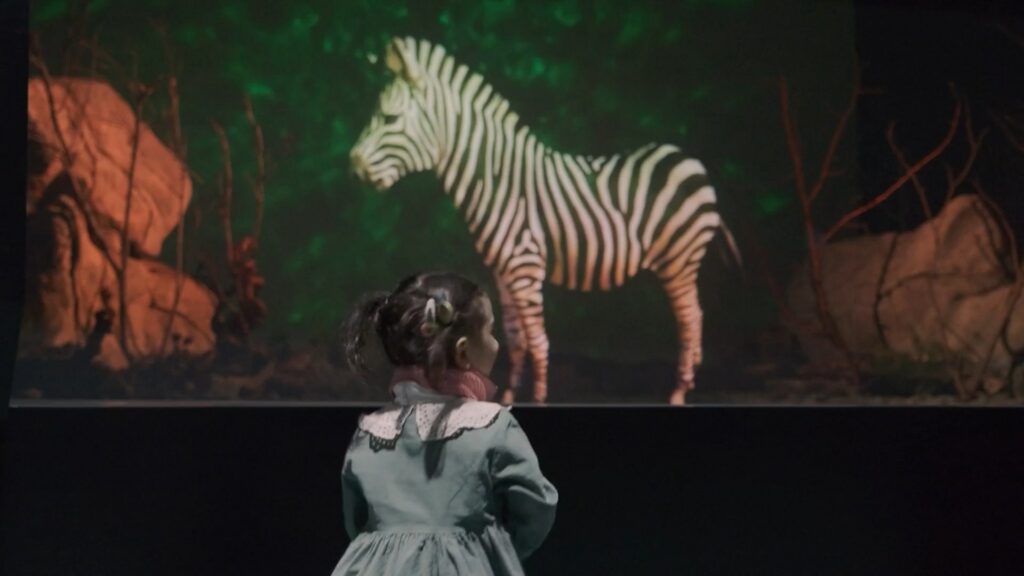
Yet for now, Holoarc is focused on introducing the technology via its Holocity Zoo & Aquarium – a compendium of 150 or so species, all moving in such a realistic fashion in their native landscape that, company founders believe, visitors’ experience will rival – or even surpass – a traditional zoo visit. The virtual creatures include a great white shark, whales, and fishes from surface feeders to deep sea denizens. Then there is wildlife such as tigers, lions, hippos, and all manner of prehistoric critters, from Tyrannosaurus rex to the Brontosaurus excelsus (yes! The old name may be returning!)
“Animals are in their natural habitats, rather than in cages,” said Tan Umut Koker, who is the technology’s visionary designer, Holoarc founder with his wife, Idil, and creator of the virtual menagerie. A native of Turkey, he has been working on computer-generated visual imagery since he was a teenager. At 15, he was one of the first users of 3D Studio Max, an early virtual modeling software program released in the mid-90s. He took off from there, earning his bachelor’s degree in computer science then, with Idil, starting their own company, Ankara Digital.

A client soon asked them to create an architectural animation of a building. Many other commissions followed. That was the start of encountering and then solving many of the challenges that have kept 3D from sensual believability. The resolution of Holoarc and Holozoo projections – part of the alchemy that creates their realism – is 16 times that of full HD resolution. “We are the only company in the world that can run in direct sunlight at the highest resolution,” said Koker.
The zoo idea came about when Koker was working as the tech advisor to Ankara’s mayor, who wanted to found a zoo in the capital city. But there was little enthusiasm in the populace for keeping animals in captivity. “Then we found a solution, a hologram zoo,” Koker said.
Creating each animal is a painstaking process that can last months or more. The entire zoo took two years of preparation. But once up, the large installation was a blockbuster in Ankara and other Turkish municipalities. To stage the zoo, Holozoo needs a big space – envision a hanger or warehouse. Each animal is in its own “enclosure,” which has actual dimensions, yet also functions as a 3D projection device. “We have a lot of technology,” Koker said. As the computer-generated animals (and background) are being created, sculptors, designers and other artists make the “rocks,” and other props that the creatures stand on, or interact with.
“When we opened the zoo we had 700,000 visitors in six months,” Koker said.
Koker and Mann, who has had a variety of businesses in Europe and Israel, met in 2017 and became friends, then business partners. They established Holoarc LLC in Austin, Texas in 2022, and moved to the Levan Center in 2023, when Holozoo Ankara wrapped up. They believe that the United States offers expanded opportunities to introduce a wide swath of people to Holoarc’s technology. The zoo may be the perfect vehicle.
Immersive experiences have become quite popular in the last few years. In Miami alone we’ve seen Superblue, a museum entirely dedicated to such fare; Yayoi Kusama’s 2024 “Love is Calling,” installation at the Pérez Art Museum Miami; and the recent “Beyond Van Gogh” at Ice Palace Studios. Mann and Koker are betting their zoo will be just as attractive.
Now ensconced in the Levan center, the company has 10 U.S.-based employees and 21 still in Turkey, whom they hope to soon bring over. They are looking for a warehouse and office space, and need about $3 million in a seed round to set up their first Florida Holozoo. Eventually they hope to raise several multiples of that to stage zoos in dozens of states. Finding a venue is key. The Ankara zoo was housed in a 30,000 square feet space, yet the bigger the space the more animals can be displayed.
So far, Koker sunk more than $5 million into the enterprise.
Meanwhile, Mann and Koker believe this is just the first step for the company and for the technology, that, if not generating as much attention as AI will have just as much of a transformative effect on people’s lives.
Mann predicts that high resolution hologram technology will soon make its way into augmented reality glasses – Holoarc is already working on its own version.
“If you ask me, in 10 or 15 years, all experiences will be going to the glasses. ” Mann said, and who added that they will replace cell phones in popularity. “It’s going to be a new world.”
Pictured at top of this post: Holoarc co-founder Tan Umut Koker with a virtual lion. Photos provided by Holoarc
READ MORE IN REFRESH MIAMI:
- She nailed it! Aurelia Edwards makes AI work in the real world
- AI, meet auto parts: A sector just begging for disruption
- South Florida startup Lamatic enables small businesses to capture the power of AI
- A fascination with acoustics, engineering and neuroscience leads to ‘hearing’ the heart

- MyMonthlyCar offers mid-term rentals for most budgets - September 22, 2026
- Petwealth’s at-home tests aim to speed up diagnosis and treatment for our furry friends - May 26, 2026
- Stem cell opportunities expand – and so does GBI - April 8, 2026