



This South Florida startup is using AI ‘not to weed people out, but to include people in’
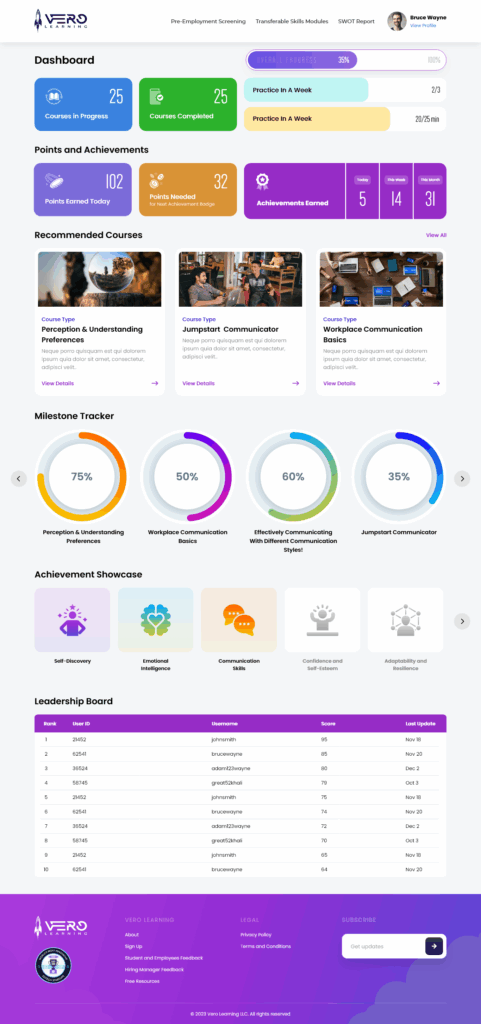
Vero Learning is tackling a massive and persistent challenge in the American workforce: the systematic mismatch between untapped Gen Z talent and real job opportunities. At the heart of Vero is a bold vision – one that flips the script on traditional hiring.
Founded by Chrissybil Boulin, the Fort Lauderdale-based startup offers a predictive intelligence platform that helps employers identify talent others overlook, streamline job placement and predict success. Vero partners with workforce development organizations and schools that are looking to connect learnings with hiring outcomes, she says.
“What separates us from an Indeed or a LinkedIn or an employee-tracking system is we look at natural competencies, real world experiences and motivation, and we predict who someone can become, not just who they’ve been,” says Boulin, Vero’s CEO, in an interview with Refresh Miami.
Since last August, Vero Learning has onboarded over 35,000 users, primarily non-traditional learners and frontline workers across high-churn industries like retail, healthcare, logistics, and manufacturing. The completion rate is 87% – particularly remarkable for Gen Z users, says Boulin [pictured above].
Boulin’s journey into workforce tech began through her work in education and economic mobility. As the founder of Jump Start Tutoring, which she still runs, she and her team have helped students achieve some of Florida’s highest SAT score increases. What made Jump Start successful, Boulin says, “was helping [students] first identify the potential they had within themselves, and giving them a plan that allowed them to maximize that.”
Now, she says, “we’re using AI with Vero Learning to scale that – not to weed people out, but to include people in.”
The stakes are higher than ever, Boulin says, with a $365 billion workforce crisis looming because of annual turnover and systemic mismatches between nontraditional talent and workforce needs. What’s more, automation is expected to displace up to 300 million jobs by 2030, according to Goldman Sachs. Boulin believes companies and institutions need smarter tools to adapt quickly.
One of Vero’s early pilots was with Office Depot, where employee churn was costing the company millions. Because existing predictive tools weren’t helping at the entry level, Office Depot invited Vero to assess employees from associate to VP level. The results? Vero’s AI predicted current job roles with 85% accuracy and flagged signs of churn before it happened. It even identified hidden strengths and potential career pathways for employees feeling underutilized, Boulin said.
Vero has expanded its focus to mid-market employers, 75% of whom lack tools to identify the talent they need, she says. Vero is also partnering with cities, school districts and nonprofits to support broader workforce transitions. One example is Vero’s partnership with a women’s re-entry program that helps incarcerated women build workforce skills. With just a handful of counselors serving a hundred-plus women, the organization turned to Vero to automate personalized career planning, including tracking skill development, and matching the women to positions in industries they may have no experience in but could be a good fit.
This ability to forecast job fit, even in the absence of traditional credentials, is what sets Vero apart, Boulin says. It’s also why American Student Assistance (ASA), the largest workforce nonprofit serving Gen Z, is a partner. In fact, ASA has already helped onboard Vero’s first 35,000 users. Now, Boulin is setting her sights on 100,000 – and beyond.
Vero’s growth strategy is built on data feedback loops; the more users it serves, the smarter its predictions become. The company is talking with research leaders like the Burning Glass Institute to help users map adjacent skill sets and career paths with precision, and Vero also plans to integrate with existing tools used by organizations to enhance predictions. This growth strategy could be transformative not only for employers but also for individuals who have historically been overlooked by rigid systems – those who lack degrees, traditional experience, or access to guidance.
“We basically are tracking the full length of someone’s journey,” Boulin said. “That’s going to be transformational particularly in a world where there is going to be so much displacement. There are going to be new jobs, but we need a way of identifying how to help people make that transition.”
With AI’s rapid rise raising concerns about bias and displacement, Boulin believes human-centric systems must teach AI to serve humanity. “The way that Vero is using AI proves that AI can be used for equity,” she says.
What’s ahead for Vero Learning? Boulin is currently raising a pre-seed extension round, now oversubscribed, and she is planning to close it in June. Boulin hopes to hit 100,000 users and begin tracking Vero’s first 10,000 job placements this year. The startup’s longer-term vision: Millions of Vero Learning users and successful job placements.
Meanwhile, Jump Start Tutoring continues to serve students across South Florida through partnerships with organizations like the Urban League, Affirming Youth, and the Boys and Girls Club. The company is also expanding into homeschooling, helping children who don’t fit traditional models thrive with custom learning plans.
“Many of our kids are falling through the cracks because education hasn’t really caught up with what we know about how people actually learn,” Boulin said. Whether it’s tutoring or workforce placement, “it’s all about meeting them where they are.”
READ MORE IN REFRESH MIAMI:
- Broward-based tutoring startup signals plans to scale through new EdTech platform
- Miami-based edtech startup TEDU raises $2M seed round
- From The Bronx to South Florida, this ed-tech founder is working to build STEAM skills for our future workforce
- For The Flock, the future of tech work is remote

- Miami startup BOB raises $5.5M to build AI-powered finance employee - October 22, 2026
- Carnegie Mellon names dean and VP of Miami campus. Let’s meet him. - October 20, 2026
- 10+ things to know in #MiamiTech: Neko Health Scans on way, big HQ move for Hut 8, Palantir & Ondas team up, Mana Tech & Notion partner, Jaca bags $1M & news from INMune Bio, MDC, CodePath, The Source, Google, LaunchEd & more - October 20, 2026