

What’s hot this year? Venture-funded startups in defense tech and healthcare were in abundance.
By Nancy Dahlberg and Riley Kaminer
It’s Miami Venture Week, and we’re celebrating startups and investors. It’s also been a time to appreciate how far Miami tech has come. At the Florida Venture Capital Conference Monday and Tuesday, the mood was optimistic and celebratory, as startups from across Florida made their best pitches for investor support.
This week’s Florida Venture Capital Conference at the Loew’s Coral Gables attracted about 800 people, including more than 200 investors from about 100 firms. Kevin Burgoyne, CEO of the Florida Venture Forum that produces the annual conference, said the Forum focused on ensuring the event had representation from both the established Florida VC community and the newer entrants to the Florida ecosystem. “Conference-wide there was a palpable, optimistic sentiment expressed by many speakers and attendees about the trajectory of Florida’s venture market,” he said.
The conference attracted a record number of startup applications to present, over 300, and 54 fund-raising startups representing seed, Series A and growth stages, were selected to make their pitches on stage, and another nine ventures were selected to attend the conference as “spotlight” companies. “Most notable was the quantity, not just the quantity of the group of startups, in terms of readiness for venture capital,” Burgoyne said. Over the years, about 2,000 companies have presented at Forum events and went on to raise over $30 billion in funding.
The 2026 presenting startups included 22 from South Florida. The others were mainly from around the state, with some from California, Pennsylvania, Ohio and other states. One Chicago-based presenting company, Solitude Labs, a cybersecurity startup that secures utilities’ grid infrastructure, took part in NextEra Energy’s 35Mules accelerator and announced on stage that they just relocated their HQ to Miami. “Florida has a unique mix of energy, industry and defense. We’re really excited to be a part of a booming and growing tech ecosystem,” said Solitude Labs CEO James Wolf.
So what is on the rise in the Sunshine State? For clues, just look at the mix of startups that presented at the Florida Venture Capital Conference this week. While AI was of course much of the talk on the stages and in the networking, more than a third (38%) of the companies presenting would be considered deep tech companies – space tech, cybersecurity, defense tech, dual use players among them.
For instance, Xpece Drones of Coral Springs designs and manufactures waterproof drones. “They can land on water, they can see underwater, and they can fly in the rain or snow to deliver a payload. That’s our first product. We’ve already shipped 800 drones,” said founder and CEO Alex Rodriguez [pictured below], during his presentation on stage. Rodriguez, who has worked in the drone industry for 15 years, says the company is moving manufacturing to the USA to sell to the government. Who were Xpece Drones’ earliest customers? “We kind of invented drone fishing.”

Zulu Pods of Coral Springs, co-founded Daniella and Rob Sladen [pictured below, at right], is a vertically integrated aerospace company that designs and manufactures critical components for missiles and drones. The startup started with one product, the Zpod, a next-generation fluid delivery system, and now has a portfolio of offerings. “You can think of our end user as the DOD,” Sladen said, “We work with Lockheed, Honeywell, Rolls Royce, Beehive, Sikorsky, to name a few. And then we’ve also gotten funding from the Navy, the Air Force and the Army to underwrite a lot of our research over the last few years.”

LuftCar of West Palm Beach is “building the connected air-ground ecosystem for tomorrow,” says Santh Sathya, of LuftCar. The advanced air mobility company is developing a hydrogen-powered heavy-lift EVTOL aircraft, modular vertiports, and an AI-based planning platform for long-range, zero-emission air logistics. “There are use cases that we did not even think about. Our customers educated us,” Sathya said. Some of those include as heavy cargo vehicles, for getting medical supplies to remote places, as an air ambulance, or for use in law enforcement.
The second largest sector represented at FVCC was heathcare-related startups; those made up 30 percent of the bunch.
Inner Cosmos of Fort Lauderdale is a neurotechnology company developing a drug-free, home-based treatment for depression and cognitive decline, said CEO Meron Gribetz [pictured below]. It’s a penny-sized device that gets slipped under the skin in a 30-minute outpatient procedure. The company recently completed an FDA approved five-year clinical study. “We’re changing the landscape of depression by delivering precise continuous brain stimulation from the comfort of a patient’s home.”

Meanwhile, Synchronyx of Boca Raton, founded by Tamar Sapir, helps patients stay on track with their medication by making the medication package itself the connection point. It’s a pain point because many patients don’t stay on track, and Synchronyx can provide data to their doctors. “We place a battery free smart label on any package, and with a tap, the patient gets a simple companion, reminders, checkins and a fast way to share what’s getting in the way,” said Sapir [pictured below, at right], who has 25 years experience in the healthcare field.

Other South Florida startups ran the gamut from a platform for churches to increase engagement (Gospel Time) to a machine creating the perfect craft cocktail (Elyxm). There were proptech plays, edtech offerings and plenty of SaaS, and yes, as a group these startups are all-in on AI. See short discriptions here.
In speaker fireside chats and panel discussions held throughout the two days of the conference, investors and other leaders shared insights about venture success, advice for founders and market expectations. After a tough couple of years of VC Winter following the pandemic, South Florida is coming off a fairly strong year for venture capital. In 2025, venture capital investment in the Miami metro area rose 49% over 2024, as investors are finally beginning to see an opening to the exit market.
“I’m excited about the amount of dry powder on the sidelines, the amount of backlog in the IPO market,” said EisnerAmper Partner Ryan Keating, whose practice has worked with over 1,000 venture-backed early-stage companies. “What’s different now from what I’ve seen in the past with a lot of venture-backed companies going public is that these companies that have had to wait are real businesses now – these companies have had to harden their business and their margins and their growth for two or three years, waiting for the markets to open. That’s going to start to return a lot of liquidity back to investors, which is going to be able to cycle through.”
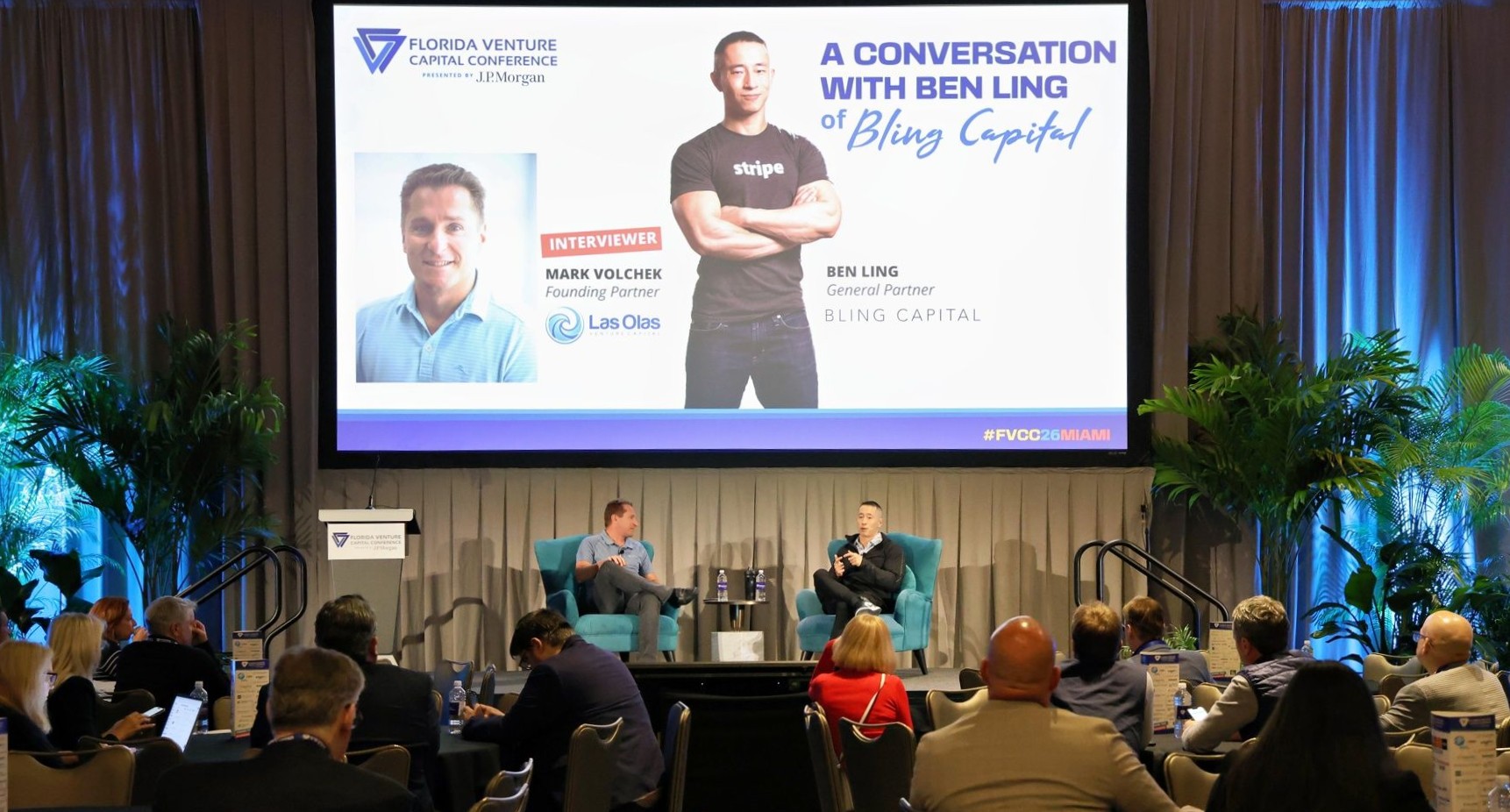
In a wide-ranging fireside chat with Mark Volchek of Las Olas Venture Capital, Ben Ling of Bling Capital traced his path from tech operator to successful early-stage investor and shared candid insights on venture strategy. After Stanford, Ling began his career at Google, where he led commerce and later major search products, and then served as a director of platform at Facebook before returning to Google for a YouTube position. He started angel investing in 2007–2008, initially backing friends with small checks. “It was just a hobby,” he said, but over time it evolved to become a career. Early on, he built a reputation as an “insurance policy” for founders navigating platform issues and as a connector who could help them raise capital.
Ling, whose fund portfolio includes 18 unicorns, emphasized that what makes an investable startup hasn’t changed: great teams addressing large markets with differentiated products that customers are addicted to using. He looks for founders who are high IQ, high EQ, resilient, and “learn it all.” He said his firm, which has backed companies such as Pinterest, Lyft, Instacart, and GitLab, targets about 40 investments, each with the capability of returning the entire fund, acknowledging many early-stage bets return less than 1x. Ling also underscored the importance of differentiated deal flow, and he leverages a network of top product leaders as LPs to surface emerging founders very early.
Looking ahead, Ling expects capital to continue to concentrate in perceived AI winners and sees a contrarian opportunity in less popular sectors like fintech and healthtech. Reflecting on success, he credited preparation and perspective: “A lot of my success is due to my hard work, but I think the preponderance of it is because of luck,” adding that as he’s gotten older he recognizes “you can’t control everything.”
Ling moved to Miami five years ago, and raised a $270 million Fund IV just over a year ago. He believes great startup ecosystems need at least one $10 billion public technology company to create the network that spawns great companies, a large pool of investors and firms (that he says Miami already has); strong universities that birth great engineers, although he said that may be changing somewhat with AI; and great K-12 schools for tech founders’ families. New York and LA are on the way to becoming great ecosystems, he said. What does he think about Miami? “We have some work to do here, but I think it takes time.”

At the top of the Florida Venture Capital Conference’s day 2, investors described a venture market that is not contracting but dividing. AI-native startups are raising large rounds under a new set of expectations, while companies outside the category face tougher scrutiny around efficiency and execution.
Brian Model, managing partner at Topmark Partners, summed up the shift clearly: “It’s almost like two different systems entirely,” noting that non-AI founders still have strong opportunities, but must now demonstrate profitability, runway discipline, and measurable value.
Robert Cousin, Palm Beach-based managing director in J.P. Morgan Global Alternatives’ Private Equity Group, framed the moment as a structural change rather than another tech trend. “It’s a have and have-nots industry, and the haves have all the money,” Cousin asserted, while emphasizing that capital remains available for founders who align with the right investors. He pointed to the growing momentum across Florida in sectors like defense, healthcare, and space, adding t hat a potential wave of IPO activity could re-energize venture more broadly.
Dana Sadovnic, Principal at Radian Capital, challenged the narrative that SaaS is fading, arguing that market understanding and execution still matter more than the underlying code. “The hard part wasn’t necessarily the tech,” she said, adding that AI will soon become a standard layer across products rather than a defining category. Her firm is increasingly focused on companies benefiting from AI infrastructure growth, while also viewing marketplaces as durable businesses built on trust and relationships that automation cannot easily replace.
Despite the AI spotlight, this panel’s advice to founders was grounded. Metrics have overtaken storytelling as the core fundraising driver, with Sadovnic – a Miami native – noting that data around retention, conversion, and distribution now forms the opening argument. Cousin delivered the simplest takeaway: “The number one rule is don’t run out of money.” Model reinforced the point from an operating lens, warning founders to project realistic targets because “don’t miss your numbers” remains one of the clearest signals of execution.
This discussion along with others reflected a venture environment that feels more disciplined than the last cycle – still optimistic, but increasingly driven by proof, capital efficiency, and the practical ways AI is being applied across the broader startup economy.
Stay tuned to Refresh Miami as we check in with more startups in coming months.

READ MORE IN REFRESH MIAMI:
- Defense tech, digital assets and AI take the stage at iConnections 2026 Global Alts Miami
- Palantir plants its HQ flag in Miami
- Miami area startups raised $613M in Q4, PitchBook reports. What were the top deals?
- 2026, according to the VCs writing the checks
- #MiamiTech in 2025: Growing up without slowing down
- Big Sky Capital is the bridge between Fort Lauderdale and Central Asia
- Years after the Bitcoin theatrics, Peter Thiel puts real roots down in Miami
- From Miami to the World: How a Miami 16-year-old is scaling access to tech education - October 15, 2026
- MDIA lands $3M Knight Foundation investment to expand its innovation model nationwide - October 14, 2026
- Ambition Accelerated kicks off statewide accelerator in key sectors. Here are the 19 South Florida startups selected - October 13, 2026