


By Karen-Janine Cohen
It’s no secret among bio-researchers that Black people, women, older adults, children and many of those from various ethnic populations are under-represented when it comes to testing drugs, and compiling clinical trial data.
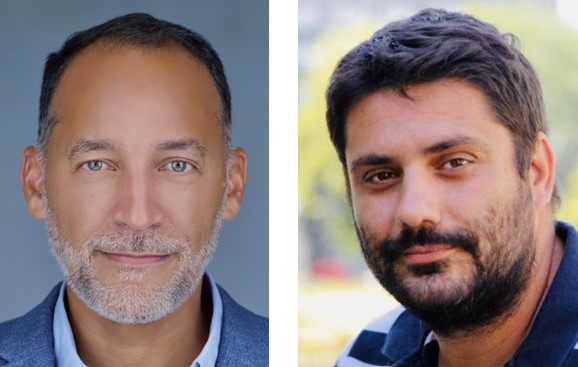
Edison Sabala and Vlada Kopric [pictured above], co-founders and, respectively CEO and CTO of startup Neotypica, saw that too, and figured out a solution. Neotypica is using AI to find folks from under-represented groups. The ultimate goal is for them to enroll in drug and clinical trials being conducted by a variety of organizations, from hospitals to physicians groups.
“We realized there are a lot of operational issues when it comes to recruiting under-represented communities,” said Sabala. The two founders’ expertise in research and technology combine to create a pathway toward addressing that issue.
“People all over the world are not represented in studies,” Sabala said, adding that without the participation of robust parts of the human population, the effectiveness of drugs and the accuracy of clinical research could be less robust. What’s more, academies and governments see this as a problem as well, and there is an increasing push for more inclusion.
The role of AI is to make finding targeted populations – think people of color, women, older adults, children and Hispanic and Latino groups – much less time consuming. That is the first step in getting their informed consent to participate in research.
Historically, it has been those with higher educations and incomes who are willing to take part in clinical research. Reaching out to other populations is key to changing that.
Sabala, born in the Dominican Republic, and raised in New York, comes to the space after long experience in medical and bio-technology. He earned a dual degree in philosophy and chemistry at the City University of New York, followed by a master’s in public health from Columbia University. He was working as director of research at the division of Stroke and Cerebrovascular Disease at Columbia University’s Department of Neurology when the University of Miami recruited his boss, and Sabala came with him. He worked at the university while earning an MBA there as well.
Meanwhile, ideas began to jell. “When you do something for long enough, you begin to think about how you can do things better,” he said. The question was: what were the problems in clinical research, and, could AI be leveraged to address them?
That is what Neotypica does. It both uses commercial and proprietary data collection while also creating its own large language model to find and target under-represented populations. Clients would include pharmaceutical companies, foundations, associations dedicated to fighting diseases, and academic centers involved in clinical research.
So far, Neotypica has one client, a bio-repository that is collecting tissues to study dermatological diseases. Five more in the pipeline. Sabala and Koprik met as board members of Miami’s chapter of AiSalon, a global group dedicated to connecting and collaborating on the emergent technology. Koprik, said Sabala, has been working on large language models for about 15 years. The firm, founded in 2024, is certified as a BCorp and is in the pre-seed process of raising $1 million.
The company has four employees including the co-founders. Along with developing their algorithms and proprietary software, Neotypica is reaching out to doctors, clinics and other locations in real time to find more of their targeted populations.
Indeed, when interviewed by Refresh, Sabala was himself in the DR, talking to doctors and other health care professionals, seeking out ways to identify more participants.
READ MORE IN REFRESH MIAMI:
- Advanced robotics startup NAVIGANTIS secures $12M to pioneer a new chapter for stroke care
- CourMed, a private client health and wellness startup, rides a healthy growth trajectory
- Peli Health: A one-stop shop for pelvic health education and support
- FloSpine secures $1.7M in funding as it focuses on sales of flagship medical device
- Fast-growing Boca startup HelixVM is ‘breaking new ground’ in telehealth

- MyMonthlyCar offers mid-term rentals for most budgets - September 22, 2026
- Petwealth’s at-home tests aim to speed up diagnosis and treatment for our furry friends - May 26, 2026
- Stem cell opportunities expand – and so does GBI - April 8, 2026