


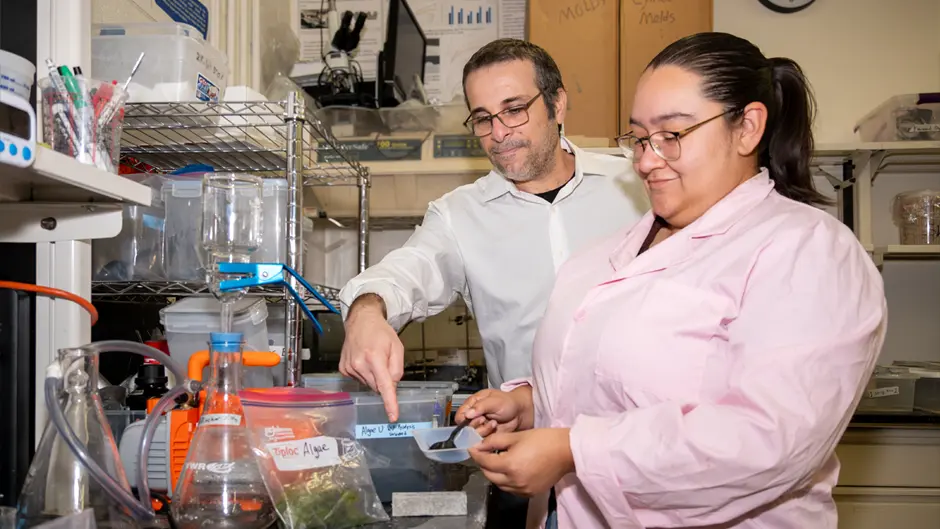
By Robert C. Jones Jr./ University of Miami News
Food scraps, seaweed and the construction industry may seem like strange bedfellows, but such an unlikely combination could actually result in stronger, greener infrastructure, improving everything from buildings and bridges to power grids and pipelines.
A University of Miami College of Engineering researcher who directs a lab dedicated to producing innovative materials is perfecting a method that would help make such refinements to the built environment possible — and it all starts with bio-based products.
“We waste an incredible amount of food, and much of it is discarded and sent to municipal landfills where it decomposes and produces a potent greenhouse gas,” said Ali Ghahremaninezhad, a professor in the Department of Civil and Architectural Engineering, noting that up to 60 million tons of food is wasted in the U.S. each year.
At the same time, millions of tons of sargassum seaweed floating in the Atlantic Basin and Gulf of Mexico regularly reach and inundate beaches from Florida to Texas each year, decomposing on shore and producing toxic gases such as hydrogen sulfide and ammonia that can lead to health impacts.
“But what if we could take those kitchen scraps as well as other agricultural byproducts, seaweed, biochar and even plant-derived proteins and enzymes, incorporate them into concrete and help transform the way we build modern infrastructure?” Ghahremaninezhad said.
Armed with a $600,000 four-year grant from the National Institute of Food and Agriculture, an agency within the U.S. Department of Agriculture, he hopes to do just that.
Through his Advanced Infrastructure Materials Research Lab, Ghahremaninezhad and a team of graduate and undergraduate students will infuse bioproducts into cement as part of their ultimate goal of creating a type of “green” concrete that could be used in a multitude of construction projects.

“Concrete is one of the most-used materials in the world, going into bridges, buildings, roads, seawalls and a lot more infrastructure,” Ghahremaninezhad said.
But the process of producing it, he noted, accounts for about 8 percent of global carbon dioxide emissions, primarily because of the volcano-hot temperatures required in the manufacturing of the key binding agent—cement.
“Infusing bioproducts, bio-based polymers, coatings and marine-derived resources like sargassum into cement can not only help lower carbon emissions and preserve natural resources but also results in an eco-friendly ‘green concrete’ that rivals and even exceeds the durability of concrete made through traditional methods,” said Ghahremaninezhad, noting that early testing has already proven the strength of such biowaste-infused concrete.
The concrete his team will produce will also have self-healing properties, allowing it to slow the corrosive process in humid, salty environments.
“Our project extends beyond concrete,” he said. “We hope to apply the technology to metals because many infrastructure projects, from bridges to towers, are metallic structures.”
At some point during the project, Ghahremaninezhad and his team will field-test concrete samples in the real world, perhaps in a marine environment.
While the critical aspects of the research will be conducted out of Ghahremaninezhad’s lab, other University entities will make significant contributions to the project, including the College of Arts and Sciences, the Rosenstiel School of Marine, Atmospheric and Earth Science and the Frost Institute for Data Science and Computing.
“The interdisciplinary nature of the project is important because developing and processing biological materials requires expertise that extends beyond traditional civil engineering and materials science,” Ghahremaninezhad said. “Biologists and biochemists, for example, will help investigate the extraction and processing of proteins, enzymes and other useful components from biological waste.”
Other team members will employ artificial intelligence to identify optimal concrete mixture proportions and help determine how much of each bioproduct should be used to achieve the best combination of strength, durability and performance, according to Ghahremaninezhad. And AI-assisted imaging and analysis, he said, will be used to detect cracks in concrete, allowing researchers to determine where self-healing technologies should be deployed.
Arizona State University researchers will also collaborate on the project, though their precise role is still being determined, according to Ghahremaninezhad.
Undergraduate students will work alongside graduate assistants, participating in laboratory experiments, data collection and analysis.
Doctoral student Jasmine Rodriguez’s own research in using sargassum from local beaches to create sustainable concrete mirrors is part of the project. “We’ve been trying to pyrolyze seaweed and turn it into this biochar material in order for us to be able to lock in a lot of the carbon that the sargassum sequesters and then put it into our concrete materials. So, this project couldn’t be timelier and more exciting,” she said.
“As long as humans exist, there will be agricultural bioproducts, and as long as humans live, we will need infrastructure,” Ghahremaninezhad said. “We’re helping to establish a new generation of engineers with expertise in combining biological materials and infrastructure technologies.”
 “Producing sustainable and durable concrete is just one aspect of what we’re trying to accomplish,” he said. “Our efforts will help divert waste from landfills, minimize resource extraction, mitigate the impacts on the environment and contribute to a more circular economy.”
Robert C. Jones Jr is a writer for University of Miami News. This story was produced by University of Miami News and reposted here with permission.
Pictued at the top of this post: College of Engineering professor Ali Ghahremaninezhad and Ph.D. student Jasmine Rodriguez prepare sargassum seaweed as an additive to strengthen concrete. Photo: Betsy Martinez/University of Miami
READ MORE IN REFRESH MIAMI:
- A humanoid joins UM’s RoboCanes team
- How a University of Miami startup is using nanotechnology to transform agriculture
- From Star Trek to the clinic: UM’s 3D bioprinting facility for personalized medicine is engineering molecules for patient implantation

- With USDA grant, UM research team is turning discards into durable infrastructure - November 27, 2026
- Florida Atlantic hosts inaugural statewide quantum hackathon championship - November 27, 2026
- Over 600 acres in South Dade could become an aerospace tech manufacturing hub - November 25, 2026