


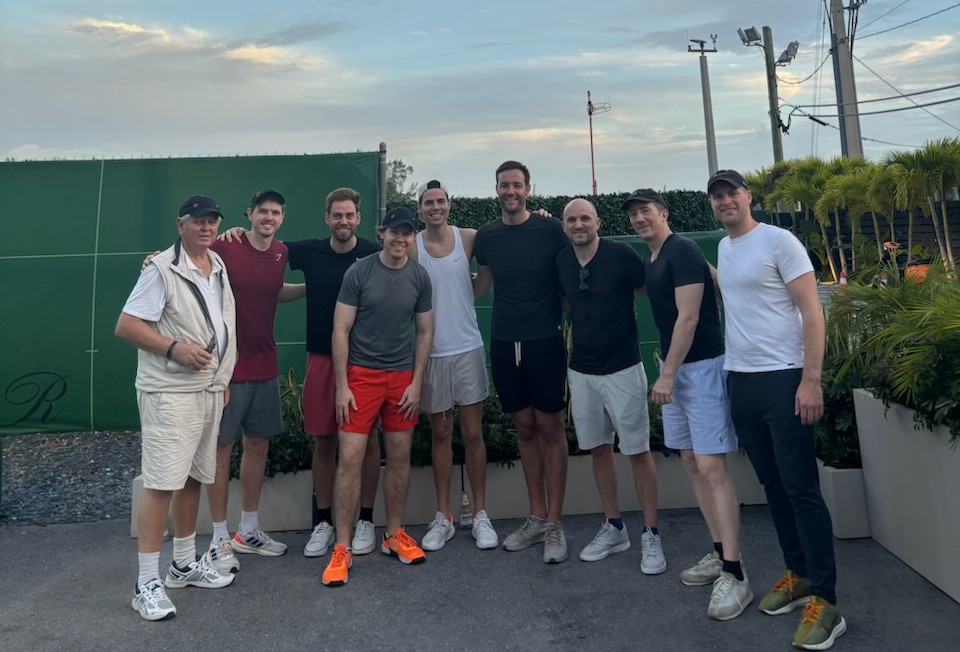
Sidney Powell didn’t exactly plan on ending up in Miami. In fact, when the pandemic hit, the Australian native was still living in Melbourne, enduring strict lockdowns. After relocating briefly to Sydney, and watching that city follow suit, Powell decided he could do better.
He came to the U.S. in late 2021 to meet with clients and investors, found himself returning to Miami again and again, and by that Christmas had settled here for good. Soon after, he met his now-wife at a conference, cementing both his personal and professional ties to South Florida.
From his base in South Beach, Powell [pictured above] now runs Maple Finance, an on-chain asset management firm he co-founded in 2019. Maple manages more than $3.3 billion in assets and has facilitated more than $7 billion in loans. The vision, Powell told Refresh Miami, is to “build a new version of an Apollo or an Ares by riding the next wave of finance: stablecoins, tokenized assets, and the shift of capital markets onto the blockchain.”
That’s an ambitious target, but Powell has always thought big. A former banker, he left the corporate world to work at a smaller financial company, where he first met his co-founder, Joe Flanagan.
“We initially asked ourselves, could we tokenize bonds so we could do what we were doing but on a blockchain?” Powell said. After testing different approaches, Maple landed on institutional lending, providing large-scale loans backed by crypto collateral.
Today, Maple Finance operates as a stablecoin-based lender, extending loans from $5 million up to $100 million to exchanges, crypto miners, trading firms, and family offices. Borrowers typically post Bitcoin or Ethereum as collateral, though Powell said Maple could one day accept other tokenized assets as those markets mature. “We want to serve customers as they are, not just where we want the technology to be,” he explained.
On the other side of the equation, Maple offers yield products that attract corporate treasuries, hedge funds, and high-net-worth individuals seeking stronger returns than traditional credit markets can provide. Crypto lending currently offers yields of 7 to 10 percent, and Maple takes a cut of the interest spread to generate revenue.
With about $1.1 billion in loans outstanding, the company’s revenue run rate is roughly $16 million, a figure Powell expects to nearly double by the end of the year.
What sets Maple apart, Powell argued, is how it sits at the intersection of several major trends. In traditional finance, private credit has become one of the fastest-growing areas as banks pull back from corporate lending. At the same time, stablecoin adoption is surging, driven by lower transaction costs and faster settlement compared to card networks. And Bitcoin continues to cement its place as a legitimate asset class.
“The boomer generation had real estate as their vehicle for wealth accumulation,” Powell said. “For millennials and Gen Z, it’s going to be crypto.”
Miami, it turns out, has been the perfect backdrop to build this future-facing business. Our city’s crypto-friendly policies, central time zone, and role as a gateway to Latin America make it an attractive hub.
“It’s probably a top two city in the U.S. for crypto now,” Powell said. “There’s a great network of founders and funds here, and I even play padel every week with other crypto entrepreneurs and VCs.”
Despite Maple’s international footprint, Powell is currently the company’s lone Miami-based employee – but he doesn’t intend to stay that way: “I’m always looking to hire more people here to keep me company.”
Looking ahead, Maple is pushing into securitization deals, new Bitcoin yield products, and deeper partnerships with traditional finance firms. The goal is to grow assets under management to $5 billion by year’s end.
But for Powell, it’s not just about the numbers. It’s about capturing a once-in-a-generation shift in how financial markets operate. “All capital markets activity is eventually going on chain,” he said. “The question is, who’s going to build the institutions that make it happen?”
READ MORE IN REFRESH MIAMI:
- Crypto keeps building in Miami, and investors are paying attention
- Inside CAT Labs, the Miami startup racing to stop crypto crime before it vanishes
- GoQuant nabs $4M to make crypto trading faster than ever
- Crypto-rich, house-poor? Milo has a mortgage for that
- Online crypto casino MyPrize lands $13 million pre-launch

- Dapta raises $6M to give Main Street businesses an AI advantage - October 13, 2026
- David Blumberg on why Miami’s tech moment is still gaining ground - October 13, 2026
- This Miami startup thinks your home should have a signature scent - October 12, 2026