


The European Union has a comprehensive legal framework on Artificial Intelligence in effect since 2024. In contrast, the United States has no federal legislation and instead a patchwork of state and local laws on AI. President Trump has said he opposes “any form of globalist regulation or anything to control or stifle” AI, vowing the US would not permit it.
How can the 27-nation EU, with 450 million people, and the US, with 350 million people, two of the world’s strongest economic forces, best work together to minimize risk and protect consumers from a new technology that some fear might go rogue?
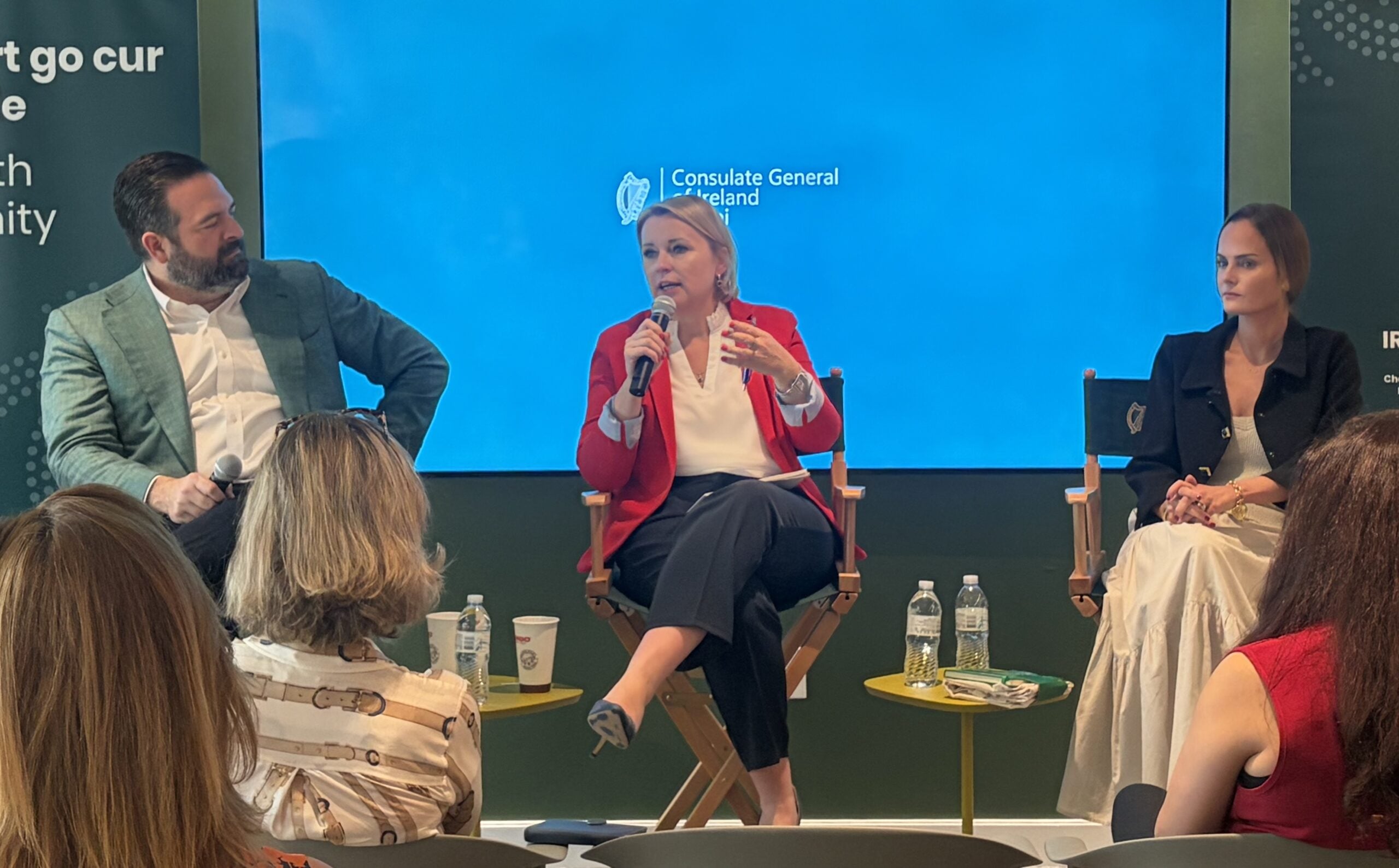
That was the topic of a lunchtime panel Nov. 20 held at the Irish consulate in Miami and featuring the EU Ambassador to the US Jovita Neliupsiene, the first woman to hold the post, and Melissa Medina, CEO of eMerge Americas, the group promoting South Florida as a tech hub. Neliupsiene hails from Lithuania, the Baltic nation known as a fintech hub.
Europe’s risk-based, comprehensive approach to AI
Neliupsiene said the European Union’s AI Act enacted in 2024 introduces a risk‑based system, with four tiers: minimal, limited, high and unacceptable. Only unacceptable risks are banned, such as manipulative AI and real‑time biometric identification in public spaces. The act applies to all entities with products and services used in the EU, even if the provider is located outside the European Union. The obligations of the act are applied progressively through 2028.
“The major premise is how to make sure to build the trust,” so citizens feel protected using the technology, in what some call a pre-harm approach, Neliupsiene said. “We’re regulating about 5 percent of AI: the most risky, fundamental rights,” including health, security and defense-related data. “The rest is not totally Wild, Wild West, but there is a kind of shared responsibility with the companies.”
The AI Act combines with the EU’s Digital Services Act, a comprehensive legal framework for online platforms, aimed to ensure user safety, transparency, and accountability. That law aims to protect vulnerable groups from scams, propaganda and other online risks, she added.
The US innovation-first approach to AI
In the US, the approach to AI instead prioritizes innovation, with risky problems often tackled later, sometimes through litigation in what some call a post-harm approach. Trump opposes federal AI regulation, with some 1,600 AI-related laws now mulled on state and local levels.
“Founders just want to innovate, but there needs to be a balance,” Medina told the audience. “Where is that fine line where regulation doesn’t stop innovation?”
Neliupsiene suggested the EU and US work closer together to set “Western standards” that can be “on the winning side” in AI competition globally. She said supplies for AI ventures in the US already come from the Europe Union: semiconductor printing machines from the Netherlands, lasers from Germany, and battery magnets often from Estonia, the EU ambassador said.
“It’s a huge supply chain, so we have to start talking about trusted vendors and suppliers to really compete with China,” Neliupsience told the audience.
The Trump administration instead has focused on restricting US sale of advanced AI chips to select nations. This month, the US Commerce Department this month issued an interim final rule to require a license to ship advanced AI chips to Indonesia, Malaysia, Singapore, Thailand and Brazil, countries it says “present a higher-than-normal risk of diversion,” news reports said.
But many US groups seek stronger guardrails on AI to protect users, jobs and democracy. US-born Pope Leo has called AI humanity’s biggest challenge and urged robust AI regulation. US Catholic bishops say they’ll keep “monitoring labor impacts and advocating for workers.”
Moderating Friday’s panel was lawyer and lobbyist Jose Felix Diaz, executive vice president of Ballard Partners and a former Florida state representative. The Republic of Ireland has keen interest in AI, because of its role as a hub for tech manufacturing and services in the EU. Among tech companies present in the English-speaking nation of 5 million people are Google, Meta, Apple and South Florida’s Kaseya.
Pictured at the top of this post: EU Ambassador to the United States Jovita Neliupsiene is speaking, with at left, panel moderator Jose Felix and at right, eMerge Americas CEO Melissa Medina.
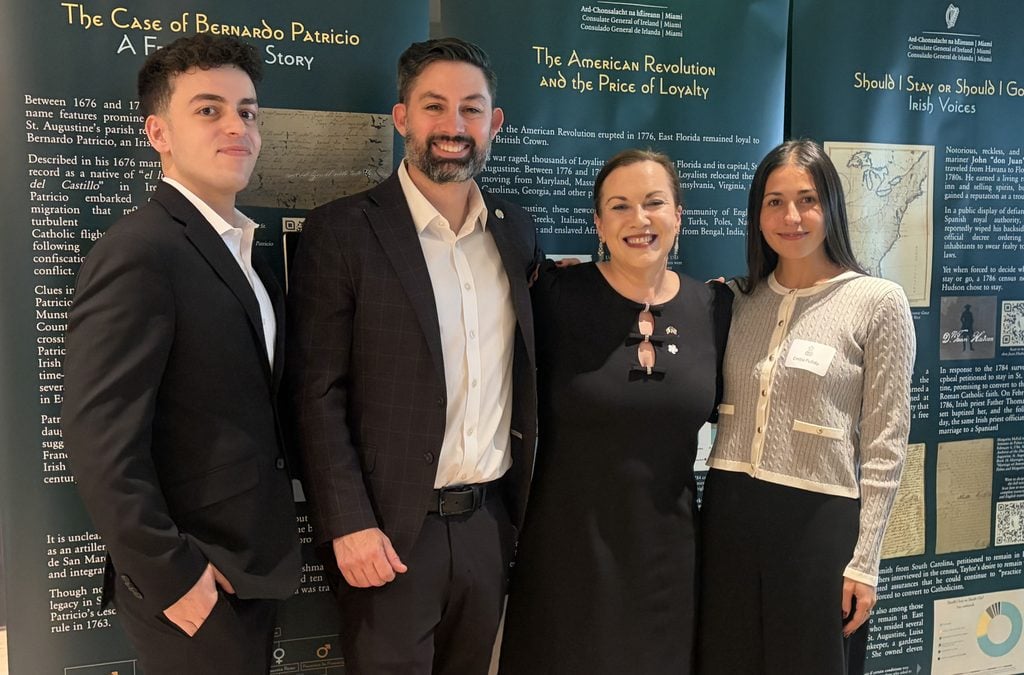
Pictured above: Ireland’s consul to Miami Sarah Kavanagh (center) at the consulate’s exhibit on Irish history in what is now the US, including the first St. Patrick’s Day parade in the US in St. Augustine, Florida, in 1601. At that time, St. Augustine was a Spanish colonial settlement.
READ MORE IN REFRESH MIAMI:
- High-level Lithuanian delegation visits Miami to strengthen links in tech and business
- OpenFX launches venture arm; has invested in Miami’s Jeeves and Cyclops
- Israel tech-investment conference reset for Dec. 14 in Miami Beach
- Now launching: Goodness, an AI-powered operating system giving nonprofits more time to focus on their missions
- Born out of the Palisades fire, Miami’s AidFinder wants AI to be every disaster survivor’s case manager

- How to regulate AI: EU, US and other approaches - November 23, 2026
- OpenFX launches venture arm; has invested in Miami’s Jeeves and Cyclops - October 15, 2026
- Music Tech mission from Spain heading to Miami in October - October 7, 2026