



Jason Goldberg has seen the same story play out too many times: a trader sets up a wallet, buys into the hype of a hot token, then loses money through a mix of market swings, bad timing, and clunky tools. “The wallet is the most important user gateway in crypto, yet most wallets remain basic signers,” Goldberg shared in an interview with TFN.
That frustration is what led him, alongside co-founders Sarvesh Jain and Ignas Peciura, to launch Miami-based Senpi earlier this year. The startup is betting that wallets should do far more than just hold assets.
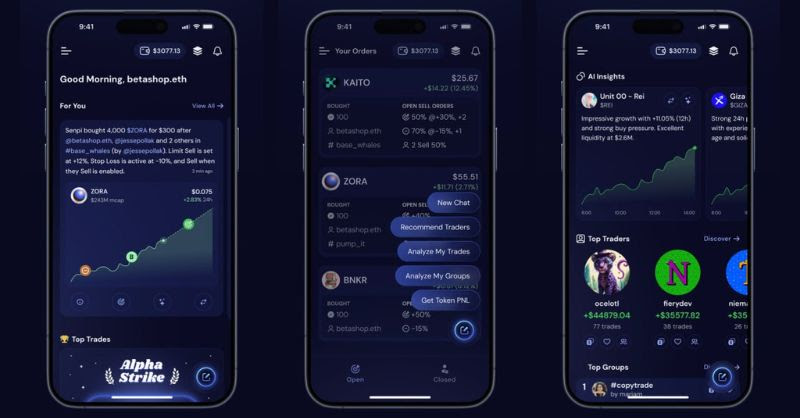
With the help of autonomous AI agents, Senpi is turning wallets into active partners that trade, analyze markets, and even copy top performers, all without users needing to constantly watch charts.
In just four months since going live, Senpi’s users have already executed more than 250,000 automated trades. According to the company, the AI has achieved a success rate close to 45%, about three times higher than what traders usually see on comparable platforms.
That traction caught the attention of investors: Senpi just closed a $4 million seed round led by Lemniscap and Coinbase Ventures.
Goldberg explained that Senpi is designed as a “simplification layer” for an industry that has grown too complex for most retail traders.
“As trading, yield, and tokenised asset opportunities expand across chains, retail faces overwhelming complexity. Senpi is the simplification layer that makes these advanced strategies accessible to everyday users in a familiar, consumer-friendly wallet experience,” said Goldberg, Senpi’s CEO [pictured above].
“Senpi is positioned to lead the era of autonomous AI financial agents. If successful, it becomes the default way millions of users put their money to work on-chain — a category-defining company at the intersection of AI and finance.”
Beyond its autonomous trading bots, Senpi offers features that speak to both seasoned and novice traders: copy trading to mirror the best performers, customizable strategies with profit targets and stop-losses, real-time P&L tracking, market sentiment analysis, and risk management dashboards. Its non-custodial design also means that users keep their private keys, since Senpi never touches customer assets.
That approach differentiates Senpi from others in the space. Competitors like Rivo Wallet use AI to make portfolio suggestions, while popular incumbents like MetaMask and Coinbase Wallet focus on usability and security. But few wallets have built fully autonomous, on-chain agents that can act on behalf of the user, as Senpi has. The company is also opening up its modular architecture to developers, inviting them to create their own trading features on top of the wallet.
The roadmap is ambitious. Senpi plans to expand quickly across iOS, Android, and web, with developer SDKs to foster an ecosystem of third-party tools. Upcoming capabilities include multi-chain support, yield farming, perpetual futures, and fully autonomous portfolio management. The team is also planning community engagement through token airdrops tied to its Moxie Protocol.
Goldberg framed it as the next evolution of crypto wallets: “We plan to continue applying AI intelligence to reinvent the wallet as the consumer’s intelligent market-beating co-pilot, helping users navigate markets and create personal wealth.”
READ MORE IN REFRESH MIAMI:
- From Australia to South Beach, Maple Finance is building the future of finance on chain
- Transak raises $16M to scale stablecoin payments, and Miami is central to the plan
- Crypto keeps building in Miami, and investors are paying attention
- Rails launches with $14M to fix what FTX broke
- Inside CAT Labs, the Miami startup racing to stop crypto crime before it vanishes

- doxx.net raises $38M to put AI agents on a shorter leash - October 1, 2026
- Jeeves raises $110M to take its stablecoin play global - September 30, 2026
- It’s a deal, #MiamiTech! Carnegie Mellon to open a Wynwood campus - September 30, 2026